OWNER'S MANUAL


The illustrations and description
in this booklet are indicative only and the manufacturer reserves
Itself the right to introduce
any modification it may deem necessary for better performance or for
constructive or commercial
reasons without prior notice.
MOTO GUZZI S.p.A.
Technical pubblications
/Cod. 01 90 00 30
Printed in Italy
Dear rider
First of all we wish
to thank you for choosing this motorcycle of our production.
By following the instructions
outlined in this manual you will ensure your bike a long and troublefree
life.
Before riding, please
read thoroughly this manual in order to know your motorcycle's features
and how to operate it safely. All major checking and overhaul jobs are
best carried out by our dealers who he ve the necessary facilities to quickly
and competentlyrepair your Moto Guzzi.Repairs or adjustments by any other
than a Guzzi dealer during the warranty period could invalidate the warranty
right.
IMPORTANT - The text is
supplemented with schematic illustrations for quick reference and better
understanding of the subjects concerned. This manual contains some special
remarks:
 Accident prevention rules for the mechanic and for the personnel working
nearby.
Accident prevention rules for the mechanic and for the personnel working
nearby.
 Possibility of damaging the motorcycle and/or its components.
 Additional information concerning the job being carried out.
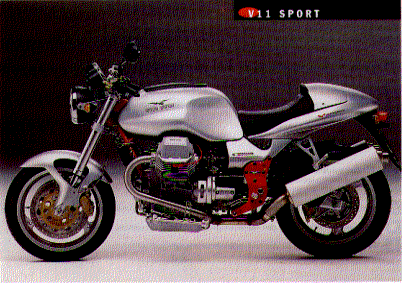
CONTENTS
Specifications
Frame
and engine numbers
Instruments
and controls
Riding
your motorcycle
Running-in
Maintenance
and adjustments
Wheel
removal
Service
schedule
Cleaning
- storage
Lubrication
Timing
system
WEBER
injection ignition system (I.A.W. 15M)
Electrical
system
Wiring diagram
SPECIFICATIONS
Engine
4-stroke, twin cylinder
Cylinder configuration
90* V-twin
Bore: 92 mm
Stroke: 80 mm
Total displacement: .
1064 cc
Compression ratio: ....
9.31
Max. torque: 9.6 kgm (94
Nm) at 6000 rpm
Max. power: CV 91 (Kw
67) at 7800 rev/min
Timing system
With rods and rockers
and 2 valves per cylinder. One camshaft in the
crankcase driven by duplex
chain with automatic chain tensioner.
Feed system
Indirect electronic injection,
timed sequential MAGNETI MARELLI IAW
15M "Alfa-N" system, 2
throttle valves 0 40 mm with Weber 1W031
injectors, electric pump
with pressure regulator, digital control of
optimised injection times.
Exhaust system
In stainless steel - 2
pipes connected to an expansion chamber
and two silencers.
Lubrication
Pressure fed by gear pump
Wire mesh and cartridge
filters on oil sump
Normal lubrication pressure
3.8-- 4.2 kg/cm2 (regulated by a special
valve) thermal expansion
valve and cooling radiator.
Low oil pressure sensor
(electrical) on crankcase.
Generator / Alternator
On front of crankshaft.
Output power: 35OW at 5000 rev./min. (1 4V - 25A).
Ignition
"MAGNETI MARELLI" Inductive
discharge digital electronics.
Spark plugs: NGK BPR 6
ES.
Spark plug gap: 0.7 mm
2 ignition coils mounted
on frame.
Starter
Electric starter motor
12V-1,2 Kw with electromagnetic ratchetcontrol.
Ring gearon the flywheel.
START <<  >> push-button on right handlebar.
Transmissions
Clutch
Dry, twin driven plates.
Located on engine flywheel. Hydraulic control
via lever on left handlebar,
Primary drive
With helical gears, 1:
1.6842 (Z=l 9/32).
Gearbox
6-speed, front engaging,
constant mesh. Incorporated Cush drive
Control pedal on left
side of machine.
Gear ratios:
1st 1:2.4000 (15/36)
2nd 1:1.7778 (18/32)
3rd 1:1.3636 (22/30)
4th 1:1.1111 (27/30)
5th 1:1.9655 (29/28)
6th 1:0.8519 (27/23)
Final drive
Cardan shaft with gears
Ratio: 1:2.9091 (11/32)
Overall gear ratios (engine-wheel)
1 st gear = 1: 11.7589
2nd gear= 1: 8.7103
3rd gear = 1: 6.6812
4th gear = 1: 5.4439
5th gear = 1: 4.7306
6th gear = 1: 4.1737
Frame
Rectangular section single-beam
in NiCrMo steel.
Semisupporting engine
base.
Suspensions
Front: MARZOCCHI,,040
mm~, upside-down hydrau lic telescopic
fork with individually
adjustable rebound and compression.
Rear: steel swing arm
with oval cross section. Single shock absorber
W. P. or SACHS with separate
adjust ment of spring preload and of hydraulic rebound and compression
damping.
Wheels
Light alloy castings with
3 hollow spokes (rear wheel with cush drive
unit). Rim sizes:
- Front: 3,50x17 MT H2
- Rear: 4,50x17MTH2
Tires
- Front: 120/70 - ZR 17"
PIRELLI MTR 01 - Corsa
BRIDGESTONE BT 57
METZELER MEZ 3
- Rear: 170/60 - ZR 17"
PIRELLI MTR 02 - Corsa
BRIDGESTONE BT 57
METZELER MEZ 3
Brakes
Front: BREMBO "GOLD series"
double semi-floating disc brake in
stainless steel with fixed
4 differential piston calipers. Hand lever
control located on the
right side of the handlebars. - 0 disc 320 mm; -
0 brake cylinder 34/30
mm; - 0 master cylinder 16 mm.
Rear: stainless steel
fixed disc brake with fixed double braking
cylinder caliper. Brake
pedal on centre-right of
motorbike;
- 0 disc 282 mm;
- 0 brake cylinder 32
mm;
- 0 master cylinder 11
mm.
Dimensions and weight
Wheel base ....................................1.471
m (57.91327 Inches)
Overall length ................................2.130
m (83.85810 Inches)
Overall width .................................0.785
m (30.90545 Inches)
Height .............................................1.090
m (42.91330 Inches)
Driver's seat height ......................0.800
m (31.49600 Inches)
Weight (dry) ......................................219
kg (481.8 lbs)
Performance
Max. speed without accessories
with one rider. 200 Km/h. (120 mph)
Refuelings
|
Description
|
Metric
|
English
|
Recommended products
|
Fuel tank
(reserve 4 1 about)
|
approx. 23
|
|
Supergrade petrol
(97 NO-RM/min.) Unleaded Petrol (95 NO-RM/min.)
|
|
Crankcase sump
|
3.5
|
|
|
|
Gearbox
|
0.850
|
|
Agip Rotra MP SAE
80W/90
|
|
Rear drive (bevel
set lub.)
|
0.370 of which
0.350
0.020
|
|
Agip Rotra MP SAE
80W/90
Agip Rocol ASO/R
|
|
Front fork (each leg)
|
0.4
|
|
Shock Absorbers oil (SAE 10)
|
Braking system (front
and rear)
Hydraulic clutch system
|
-
|
-
|
Agip Brake Fluid -
DOT 4
|
FRAME
AND ENGINE NUMBERS
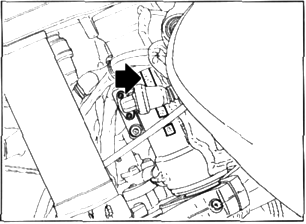
(fig. 1)
The frame number is stamped
on the clowntube; this number is entered
in the motorcycle's log-book
and is thus used to identify the vehicle for
legal purposes.
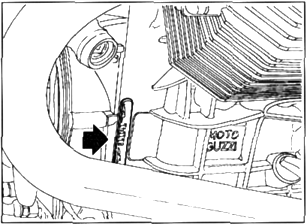
(fig. 2)
The engine number is stamped
on the crankcase.
Spare Parts
Always use approved <<Moto
Guzzi Original Spares>> only when
replacing or repairing
parts. Use of spares which are not approved
will invalidate warranty
rights.
INSTRUMENTS
AND CONTROLS
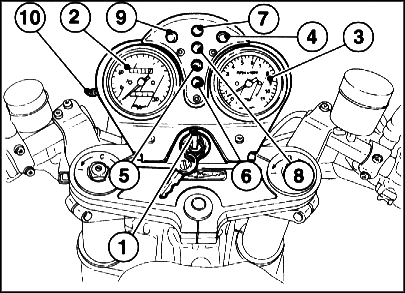
Control panel (fig. 3)
1 Key switch for devices
and steering lock.
Position
OFF -q-
vehicle stationary. Key removable
(no contact).
Position
ON vehicle
ready to be started.
All circuits are on. Key
not removable.
Position
LOCK
4m"-
steering
locked. Engine off, no
contact, key removable.
Position
P ~1*-
steering locked. Engine off; with
switch ~~A,, of fig. 5
in position ~,sooz>, the parking light is
on. Key removable.
(fig. 3)
In order to use the steering
lock mechanism, proceed as follows:
· Turn the handlebars
to the left.
· Press the key
downwards and release it, then turn it in an anticlockwise direction to
the LOCK ~
or P position.
WARNING:
Never turn the key to position LOCK ~(nfflo
oo
or P 44 F('))
when
the engine is running.
2 Odometer, tachometer.
3 Rev counter
4 Pilot light (green)
~Neutral,,. Lights up when the gearbox is in neutral.
5 Pilot light (red) for
generator current output, Should go out when the engine reaches a certain
number of revs.
6 Petro[ tank reserve
pilot light (orange).
7 Pilot light (green)
for flashing indicators.
8 Oil pressure pilot light
(red). Goes out when the oil pressure is sufficient to ensure engine lubrication.
9 Pilot light (blue) for
main beam. 10 Partial rev counter zeroing.
Light switches (figs. 4)
Are fitted to the sides
of the handle-bars.
Switch << A >>
• Position << >>
lights off.
>>
lights off.
• Position << >>
parking lights on.
>>
parking lights on.
• Position << >>
twin-filament headlamp on.
>>
twin-filament headlamp on.
Switch << G >>
With switch (lights)
in position <<>>
• Position << >>
dipped beam
>>
dipped beam
• Position << >>
main beam
>>
main beam
Horn button, passing and
direction indicators (fig. 4)
These are mounted on the
left handlebar: Push-button B pressed.
Push-button C Push-button
D: position ~,*o for right turn signals control. position w~3,> for left
turn signals control. press the switch to disconnect flashers.
flashing light control.
Starter button and engine
stop switch
(fig. 5)
These are mounted on the
right handlebar.
With the key ~1,, in fig.
3 in the ON ,0,, position, the
vehicle is ready to be
started. To start the engine,
proceed as follows:
check that switch ~,B,,
is in position (run);
pull the clutch lever
in fully;
ifthe engine is cool,
move the ~,CHOKE>, control,, E>>
into the starting position
~ 1 ~, (see fig. 4);
press the starter button
~,C>> ~,(7)>, (start).
To stop the engine in
the event of an emergency:
move the switch cB,, into
position (off).
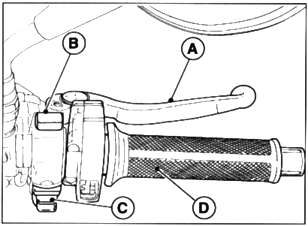
(fig. 4)
13
Once the engine has stopped,
turn the igntion key (fig. 3) anti-clockwise to the OFF ~
Before starting, move
switch ((Bn into posi tion (RUN).
Throttle twist grip (,,D,>
in fig. 5)
The throttle control is
on the right handlebar; turning the twist-grip towards the rider opens
the throttle, turning it away from the rider closes it.
Clutch lever (,(F,> in
fig. 4)
This is on the left handlebar
and must only be used when starting or changing gear.
Brake lever, r/h front
brake
(,(A~, in fig. 5) This
is located on the right handlebar and controls the master cylinder of the
right front brake.
~<CHOK& control
(,,E,, in fig. 4)
The -CHOKE,, is on the
left handlebar and is used for cold starts. 0 Position -1,, CHOKE on; starting
position. M Position ~~2,, CHOKE off; engine running.
Rear brake pedal
(,A,, in fig. 17)
This is located in the
centre of the right side of the vehicle
and is linked to the master
cylinder by a tie rod.
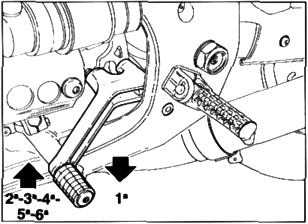
Gear change pedal (fig.
6)
Situated in the centre
of the left side of the motorcycle. Gear positions:
I st gear, lever facing
downwards;
2nd, 3rd, 4th, 5th and
6th gears: lever facing up wards;
neutral: between 1 st
and 2nd gears. WARNINGI Before changing gear disengage the clutch fully.
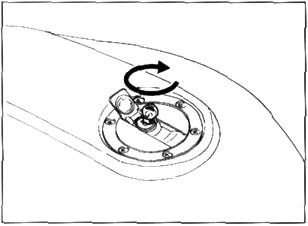
Fuel filler cap (fig.
7) To open, turn the key in a clockwise direction. N ' B ' Fuel spillage
caused during refuelling should be cleaned immediately to prevent damage
to the fuel tank paintwork. WARNING: after each refueling always check
the cap is well positioned and closed.
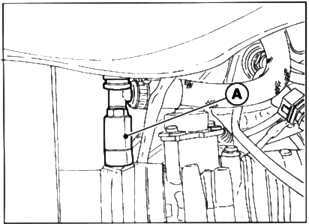
Electric fuel cock (Fig.
8)
The vehicle is provided
with an electric cock ~A,> fitted onthe left side underthetank, which operates
automati cally, cutting off fuel flow to the throttle unit when the engine
is not running.
It is activated when the
key for the switch ~ 1 , in Fig. 3 is in the ON position
Should the cockfail to
workcorrectly, first of all checkthe condition of the fuse ~~8~, on Fig.
9.
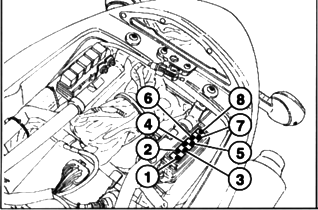
Fuse box (fig. 9)
This is located on the
right side of the motorcycle. To
access it, the side cover
must be removed and possibly
also front saddle.
The terminal board has
8 ~~ 15 Amp,, fuses.
Before changing a burnt
fuse, identify the cause of the
problem and make the necessary
repairs.
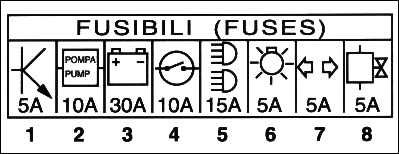
Fuse "U: ECU
Fuse 4<2n:
Injectors'coil
pump
Fuse 4": Battery re-charger
Fuse 4(4)):
Ignition
key switch
Fuse o5o): High beams,
Low beams, Horn, Start,
Stop
Fuse "6w Dipped lights
Fuse 447w
Direction
indicator
Fuse 448m:
Solenoid
Valve (Electric Cock)
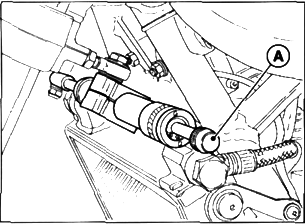
Steering damper (fig.
lo)
This is fitted on the
left hand side, between the frame and steering column base . To tighten
or loosen the steering, screw or unscrew the ring nut ,A~,. The damper
makes steering more accurate and stabe, improving the motorcycle's handling
under any condi tions.
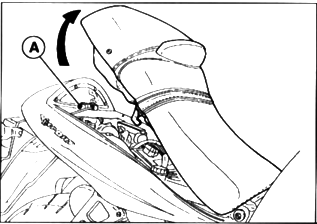
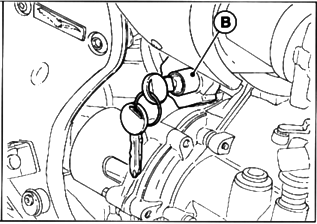
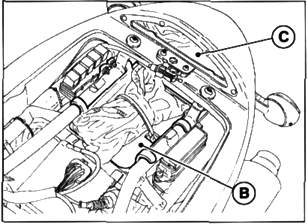
Saddlelock (fig. 11 and
12)
The driver's saddle is
locked using the device ,A,, which is operated by means of a flexible transmission
operated f rom the lock "B" f ig. 11 .
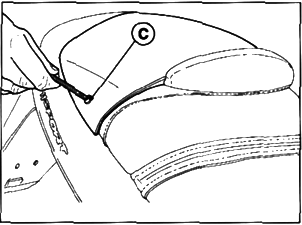
To unlock the saddle,
it is necessary to operate lock "B" and detach the saddle by slightly lifting
its rear part and removing the hooks from their seat on the f rame. To
lock the saddle, it must be placed in its seat on the f rame and then pressed
down. To detach the passenger saddle cover, unscrew the two screws "C"
on top of it Fig. 12 and remove it.
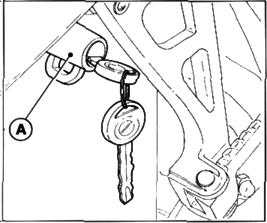
Helmet holder (fig. 13)
The helmet can be left
with the motorcycle, using the helmet holder, which is fitted with a lock
-C-.
N.B. - never leave
the helmet in the holder when the motorcycle is running, as it may interfere
with the moving parts.
Documents and objects
compartments
(,,B,, and ,C,, in fig.
14)
To gain accessto this
compartment remove the driver's seat (see Fig. 11).
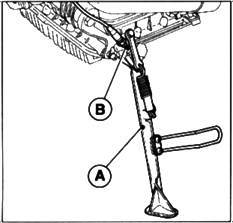
Side stand (~,A,, in fig.
15)
The motorcycle is fitted
with a side stand for parking. When the side stand is in use (i.e. in the
out position) it activates a micro-switch ~B,,, which causes the engine
to switch off if a gear is engaged.
RIDING
YOUR MOTORCYCLE
Preliminary checks
Check:
that there
is sufficient fuel in the tank; that the engine oil is at the right level;
the ignition key is in
position ON ,0,, (,<l,~, fig. 3);
that the following warning
lights are on:
red warning lights: oil
pressure and generator power
supply;
green
warning light:
indicates the gearshift is in the
,,NEUTRAL,, position;
that the ~,CHOKE>~ control
lever is in the starting
position (if the engine
is cool) (-l,>, fig. 4);
that switch ~~B>> (fig.
5) is in position (run).
Cold start After making
the above checks, engage the clutch and press the button (C ~(T),> in fig.
5). Once the engine has started, and before putting the ,,CHOKEo leverback
to its normal running position (~,2 in fig. 4), allow the engine to idle
for a few seconds in summer or a few minutes in winter.
ATTENTION!
-
If
the agreen), warning light does not come on when the ignition switch is
on (se ON oo)) in fig. 3) this means that a gear is engag:d; starting
the vehicle in this condition could be dangerous.
Before starting, always
check that the engine is in ((neutral>5.
Warm start
Follow the same procedure
as that for the cool start but without the ,CHOKE- control in the start
position
fig. 4).
WARNING!
-
The
starter motor should not be operated for more than 5 seconds; if the en
gine doesn't start, wait for 10 seconds before carry ing outthe starting
procedureagain. In any case, the starter button a C (<C>
in fig.
5 must only be pressed when the engine is not running.
With the engine running
To change gear, release
the throttle, pull in the clutch fully and engage the next gear; then release
the clutch gradually while pressing down on the throttle.
The gear change pedal
should be operated firmly and surely.
When changing down use
the brakes gradually and release the throttle gradually to avoid
over-revving
the engine, when releasing the clutch lever.
Stopping the motorcycle
Release the throttle and
use the brakes; just as the vehicle is about to stop pull in the clutch
lever fully. These three operations should be carefully coordinated to
maintain full control of the vehicle.
When slowing down in normal
conditions, use the gear box to provide engine braking to slow the vehicle;
take care not to over-rev the engine. Use the brakes (espe ciallythe
front brake) with particular care when roads are slippery or wet.
To stop the engine, turn
the ignition switch to the OFF position (see fig. 3).
Parking
On badly lit roads, leave
the parking lights on.
Turn the key switch to
position P (see figure 3),
and the light switch ,A,,
in fig. 4 to position -Dez,>; and
remove the key from the
switch.
IMPORTANT
Do not leave the switch
in the -ooz)) position for long periods as the battery will run
down.
RUNNING-IN
The recommendations below
should be followed when running-in:
Before riding, run the
engine at low revs until it has warmed up. The amount of time needed will
vary de pending on the external temperature.
Do not exceed the rpm shown
in the table; it is also advisable to run the engine at varying speeds
rather than at a constant speed.
Before stopping reduce
the speed gradually to avoid subjecting components to sudden changes in
tempera tu re.
Remember that components
need several thousand kilometers before they are properly bedded in; care
taken in this period will ensure prolonged vehicle life.
After the first 500+1500
km Change the engine oil. Shouldtheoll level droptothe minimum level
before the first 500+1500 kilometers have been completed then carry outs
complete oil change ratherthan just a top-up. Recommended oil: aAgrip
4TSUPER RAC ING SAE 20 W150o. Replace
gearshift lubrication oil. Replace transmission box lubrication oil. Check
that all nuts and bolts are tight. Check rocker clearance. Check tyre pressure
levels.
MAINTENANCEANDADJUSTMENTS
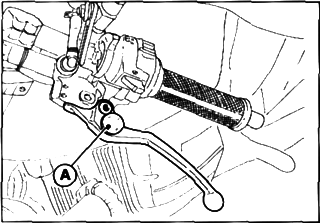
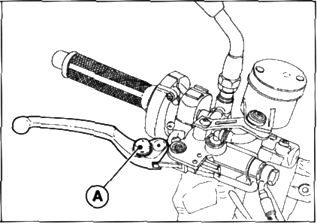
Adjusting the clutch lever
and front brake lever (fig. 16) The distance between the handle-bar and
the lever can be adjusted via the ring-nuts "A" which feature 4 adjust
ment positions.
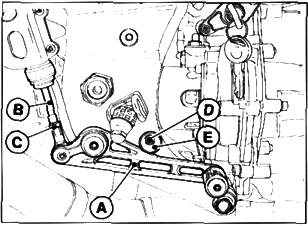
Rear brake control pedal
adjustment
(fig. 17)
Check that the pedal control
~,A,, has an idle stroke of about 5-10 mm before the rod end ,B>> operates
on the brake cylinder floating element. Otherwise, modify the rod length
~~B~>, by screwing and unscrewing it, after having loosened the lock nut
~,C>>.
If a different pedal position
A>> is desired, loosen the screw -D>> and work on the cam,~E,,. Atthesametime,
modify the rod length ~ B>>, until obtaining the prescribed clearance.
Checking brake pad wear
Check the thickness of
the brake pads every 3000 km: Wear limit: 1.5 mm.
If the pads are below
the wear limit they should be changed.
There is no need to bleed
the brakes when the new pads have been fitted; pumping the brake lever
a few times will return the caliper pistons to their normal position.
When changing the pads,
also check the hoses; if damaged they should be replaced immediately.
N.B. - Use the brakes
with moderation for the first 100 km after fitting new brake pads, to allow
the pads to get properly bedded in.
Checking brake disks
The brake disks must be
perfectly clean, with no oil, grease or other dirt on them. They should
also show no signs of scoring.
The tightening torque
of the screws that fix the disk to the hubs is 2,8-3 kg.
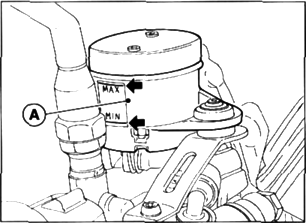
Checking the brake fluid
level in the master cylinder reservoir (figs. 18 and 19) The following
rules must be followed to ensure efficient operation of the hydraulic systems:
I Frequently check the
fluid level in the front brake reservoir ~,A,> Fig.1 8, clutch ,B>> Fig.
19 and rear brake ~,C,, Fig.20. The level should always be above the minimum
mark on the reservoirs.
2 Top up the brake fluid
when necessary orat regular intervals. Onlyuse recommended brake fluid
in sealed containers for topping up.
Fluid containers should
only be unsealed im mediately before they are about to be used. 3 The
fluid in the brake reservoirs should be changed completely afterabout every
20,000 km, or at least once a year.
To ensure efficient braking
there should be no air bubbles in the brake circuit; if the brake lever
has too muchtravel or a spongy action, this meansthatthere are bubbles
in the brake circuit.
When flushing the brake
circuits, only use new brake fluid.
Never use alcohol for
flushing orcompressed air for drying; we recommend the use of (drichloroethylenem
for metal parts.
Never use mineral oils
or greases for lubricating parts. If no suitable lubricant is available,
we recom mend the light greasing of the rubber and metal parts with brake
fluid.
Recommended fluid ~,Agip
Brake Fluid DOT 4-.
IMPORTANT. Fluid should
be handled with care, as it may dissolve paintwork.
These operations are best
carried out by an authorized dealer.
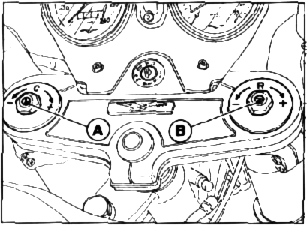
Adjustment of telescopic
fork (fig. 21)
The motorbike is fitted
with an hydraulic telescopic fork with separate adjustment of the rebound
damping and compression damping.
Hydraulic damping can
be adjusted turning adjuster screws ~,A~, and ~~B,, with a screw driver.
The righ-hand adjuster
screw ,B,, adjusts hydraulic rebound damping, the left-hand screw ,A,>
if for com pression damping.
Both adjuster screws have
several settings (clicks); turning clockwise (+) you will get a stiffer
damping, turning anticlockwise (-) will give a softer damping.
NOTE: Do nottrytoturn
theadjusters screws further than their limit positions.
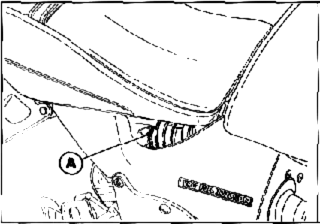
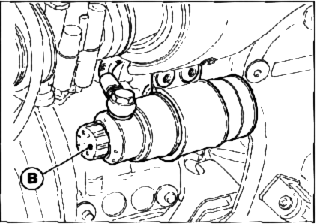
Rear suspension adjustment
(fig. 22 and 23)
The motorcycle is equipped
with "WHITE POWER"
single shock absorbers
with separate adjustment of the
springs pre-loading and
the rebound damping and
compression damping.
The shock absorber is
calibrated in the, factory to the
following standard values:
REBOUND: position 1 (ring
nut A)
COMPRESSION: position
3 (knob B)
SPRING PRELOADING: 11
mm
Use the adjusting ring
nut ,A,> shown in fig. 22 and 23
to adjust the rebound
damping.
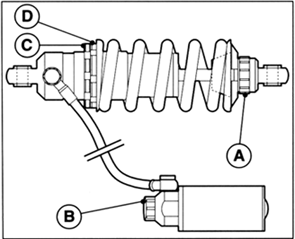
According to needs and
the load on the motorcycle, the damper can be set from position "11" (very
soft) to position "111 " (very hard).
The hydraulic damper in
compression can be set by turning adjusting knob ~(B,> in fig. 22 that
has nr. 7 setting positions; from position "I" minimum damping, to position
"T' maximum damping.
To adjust the pre-loading
of the spring, using the correct wrench, loosen off ringnut ~~C- and adjust
ringnut ,D,,; tightening up increases the spring pre-loading (see fig.
23).
The spring preload, starting
f rom a completely released spring, is 8 to 14 mm.
The released spring length
is 165 mm.
Shock absorber "SACHS
- BOGE"
As an alternative, the
shock absorber "SACHS - BOGE" type has been fifted as well. It features
the following settings:
Extension (ring nut ,A,>)
20 snaps starting from completely closed position.
Compression (knob ~B>>)
10 snaps starting from completely closed position.
Spring length in its seat:
mm 152
N.B. - To avoid damaging
the thread between
the damper body and
the ring nut lubri-
cated the thread with
<<SVITOLo, with oil or with
grease.
Max. allowed load The non
observance of the requirements for tyres pressure or load limits can affect
the handling, operation and control of the motorcycle. The max. allowed
weight supported by this motorcycle is 214 kgs (passengers + luggage +
accessories). Divided up as follows: Front axle 48 kg. Rear axle 166 kg.
Chargement maximum admis
L'inobservation des instructions
concernant la pression des pneus ou les limites de chargement peut compro
mettre la facilit6 de manoeuvre, le fonctionnement et la tenue de route
de votre motocyclette. Cette motocy clette peut porter un poids de 214
Kg maximum (passa gers + bagages + accessoires).
R6parti de la fagon suivante:
Axe avant 48 kg.
Axe arridre 166 kg.
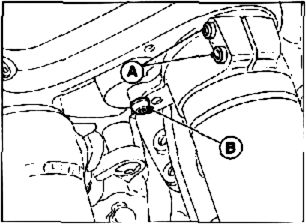
Adjusting the steering
column (fig. 24) To ensure safe riding, the steering should be adjusted
to allow free movement of the handlebars without any play. loosen the steering
head fixing bolt ,A,~; undo the steering head nut ,B,,; turn the adjuster
nut ,C,> to take up any play. When play has been adjusted tighten the nut
~B>> and the steering head fixing bolt ,A-. You are advised to have
the aformentioned procedure carried out by one of our author ised
dealers.

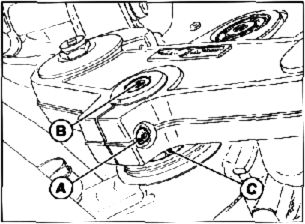
Adjusting the semi-handlebars
(fig 25) The semi-handlebar opening angle can be adjusted in three different
positions according to the driver's re quirements. To carry out the adjustment,
loosen the screws cA,, fastening the semi-handlebars to the fork. Unscrew
the semi-handlebar screws ccB,, and re-fit them on the hole in position
with the desired length. Afteradjusting, tighten the screws,,A,, tothe
prescribed torque of 0,8 - 1,2 (Kgm).
Remember to tighten
the semi-handlebar fastening screws not to run any risks when running.
After adjusting, carefully
check that the opening angle is the same for both the semi-handlebars.
WHEEL
REMOVAL
Front wheel (fig. 26)
To remove the wheel proceed
as follows:
place a support under
the bottom of the engine to
raise the front wheel
off the ground;
undo screws ~A,~ that
secure the brake calipers to
thefork, and remove the
calipers,, B,, togetherwith their
hoses;
unscrew the nut ~,C,,
that secures the wheel spindle
using a suitable wrench;
loosen the screws ~~D,,
that fasten the legs to the
spindle;
remove spindle,,E,, and
note the assembly position
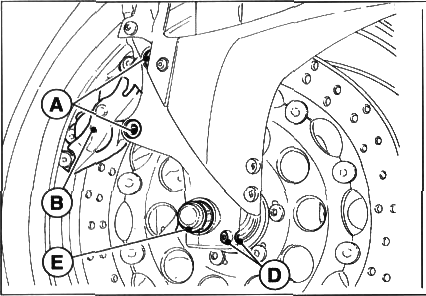
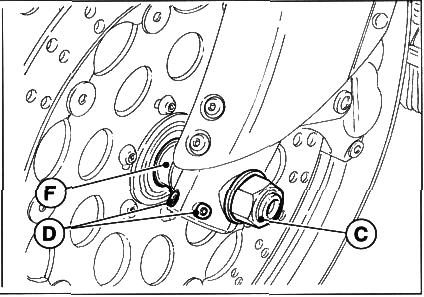
of spacer ,F,,; remove
the wheel; to reassemble follow the procedurein reverseorder, taking care
to maintain the correct position of the spacer; then pull the brake lever
repeatedly until the caliper pistons return to their normal position.
Rear wheel (fig. 27) To
dismantle the rear wheel, proceed as follows: place a central support underneath
the bike, to keep the rear wheel off the ground; unscrew the nut,,A,~ on
the brake caliper side of the fork.
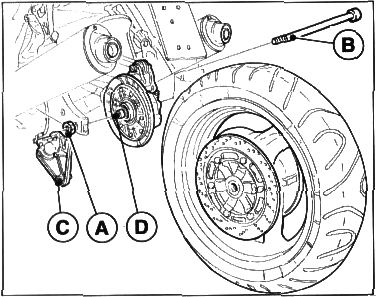
extract pin ~~B,, from
the fork arm and from the caliper-holder plate
remove the plate ,C>>
complete with caliper; completely extract the wheel pin "B" and detach
the wheel from the fork arm and from the gear-box, taking care not to lose
the shim ~~D,>.
Absolutely prevent
the detached driving box weight from stressing the couplings on the end-of-stroke
angular position, as they could be damaged.
To refitthe wheel, proceed
in reverse order, remember ing to insertthe diskwith the caliperon the
wheel pin and on the retainer of the floating fork L.H. arm.
The torque of the nut
,A>> is 12 Kgm.
Tyres
Tyres are among those
machine components which
require regular checking.
Machine stability, rider
comfort and safety all depend on
good tyre condition.
Do not use tyres with
less than 2 mm of tread.
Incorrect tyre pressures
can cause instability and ex
cessive tyre wear.
Tyre pressures:
front wheel: with one
rider 2,3 BAR; with two riders
2,4 BAR;
rear wheel: with one rider
2,5 BAR; with two riders
2,6 BAR.
These pressures are
for normal touring use. For continuous high speed cruising (e.g. on motorways)
the above pressures should be in creased by 0.1 BAR. (Only front wheel)
IMPORTANTI
If a tyre needs replacing,
use the same make and type as the first-equipment tyre. Tyre pressure ahould
be measured when lyres are cold.
Tyre fitting
This machine is fitted
with cast, light alloy rims; even though these are very strong they can
be damaged both aesthetically and mechanically by the use of incorrect
tools when removing and f itting tyres. Tyre levers should not have sharp
edges or ribbing in those places where they come into contact with the
rim; lever contact surfaces should be smooth and edges should be rounded.
Use of a suitable commercially
available lubricant facili tates tyre removal and fitting therefore making
strenu ous use of the levers unnecessary. It is important to ensure that
the tyre beads settle properly into the centre rim groove.
Some tyres have an arrow
moulded on the sidewall, in these cases the tyres should be fitted as follows:
rearwheel: arrow pointing
in the direction of rotation; front wheel: arrow pointing against the direction
of rotation.
N.B. - These instructions
should be followed unless otherwise directed by the tyre manu facturer.
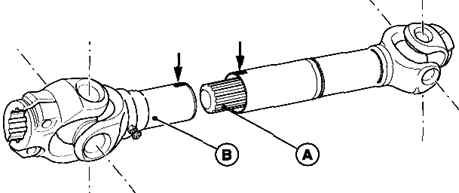
Joint unit position diagram
(fig. 28)
ATTENTION I - In order
not to damage the drive shaft - joint unit, if the unit is replaced, if
dismantled, the shaft (<A)) and the joint <<Bo must be refitted
in the position indicated in thefigure. The yellow reference marks indicated
by the arrows must be aligned.
 EY:
A = Maintenance - Inspection - Adjustment - Possible replacement./ C =
Cleaning./ R = Replacement. ccaslonally lubricate and the flexible cables,
every 500 krn (300 miles) check the oil level In the engine. any case,
replace the motor oil, the oil filter and the brake fluid, oil at least
once a year. 3riodically check the tension of the wheel spokes.
EY:
A = Maintenance - Inspection - Adjustment - Possible replacement./ C =
Cleaning./ R = Replacement. ccaslonally lubricate and the flexible cables,
every 500 krn (300 miles) check the oil level In the engine. any case,
replace the motor oil, the oil filter and the brake fluid, oil at least
once a year. 3riodically check the tension of the wheel spokes.
I Lubricate the joints
every 2 years It the distance covered Is less then 20,000 Inn
SERVICE
SCHEDULE
|
MILEAGE COVERED
|
1500 Km
|
10000 Km
|
20000 Km
|
30000 Km
|
40000 Km
|
50000 Km
|
|
ITEMS
|
(1000 mi.)
|
(6000 mi.)
|
(12000 mi.)
|
(16000 mi.)
|
(24000 mi.)
|
(30000 mi.)
|
|
Engine oil
|
R
|
R
|
R
|
R
|
R
|
R
|
|
Oil Filter cartridge
|
R
|
R
|
R
|
R
|
R
|
R
|
|
Wire gauze oil filter
|
C
|
C
|
C
|
C
|
C
|
C
|
|
Air Filter
|
|
R
|
R
|
R
|
R
|
R
|
|
Fuel filter
|
|
|
R
|
|
R
|
|
|
Spark plugs
|
A
|
R
|
R
|
R
|
R
|
R
|
|
Rocker clearance
|
A
|
A
|
A
|
A
|
A
|
A
|
|
Carburation
|
A
|
A
|
A
|
A
|
A
|
A
|
|
Nuts and bolts
|
A
|
A
|
A
|
A
|
A
|
A
|
|
Fuel tank, tank filter and pipes
|
|
A
|
|
A
|
|
A
|
|
Gearbox oil
|
R
|
R
|
R
|
R
|
R
|
R
|
|
Rear drive box oil
|
R
|
R
|
R
|
R
|
R
|
R
|
|
Shaft with drive joints •
|
|
|
A
|
|
A
|
|
|
Wheel and steering bearings
|
|
|
A
|
|
A
|
|
|
Front fork oil
|
R
|
|
R
|
|
R
|
|
|
Starter motor and generator
|
|
|
A
|
|
A
|
|
|
Brake systern fluid
|
A
|
A
|
R
|
A
|
R
|
A
|
|
Brake pads
|
A
|
A
|
A
|
A
|
A
|
A
|
CLEANING
- STORING
Cleaning
Preparations for washing
Before washing the vehicle,
the following parts should be covered with a waterproof material: the rear
part of the silencers, the clutch and brake levers and pedals, the throttle
twist-grip, the left-hand light switch, the ignition key switch, the shaft
with driving couplings and the electronic box.
NOTE: The electronic
box is located under the seat.
Washing
Avoid spraying water too
much pressure on the instru ments and the front and rear hubs.
Do not clean the joints
with high-pressure water or with solvents.
Drying
Remove the protective
coverings. Thoroughly dry the vehicle.
Test the brakes before
using the vehicle.
N.B. - To clean the
painted parts of the engine unit (engine, gearbox, transmission box, etc.)
the following products may be used: diesel oil, petrol or water-based neutral
detergents for car cleaning.
These products should
be washed off immediately with water; do not usewaterat high temperatures
or pressures.
Storage
If the vehicle is to remain
idle for a considerable period
of time (e.g. for the
winter period) it should be stored in
the following way:
clean the vehicle thoroughly;
empty the fuel tank and
feeding system. If left for a
long time, the fuel will
evaporate leaving incrustation
and residue;
remove the spark plugs
and put a few drops of SAE
30 oil into che cylinder.
Turn the crankshaft for a few
revolutions and then replace
the spark plugs;
reduce the tyre pressures
by 20%;
position the vehicle so
that its wheels are not touch
ing the ground;
smear a layer of oil on
unpainted parts to prevent
rust;
remove the battery and
store in a dry place away
from the direct sunlight
and wherethere is notdangerof
frost; check the battery
charge once a month;
cover the vehicle but
in such a way that the air can
circulate.
LUBRICATION
Engine lubrication
Checking the oil level
(fig. 29)
Check the crankcase oil
level every 500 km; the oil should reach the -Max~, mark on the dipstick
-A,,. If the oil is below this level, top up with the recommended type
and grade of oil.
N.B. - The oil level check
should be carried out after the engine has run for a few minutes: the dipstick
plug aA~) should be screwed up com pletely.
Engine oil
Good engine oils offer
special features. Only use oils with high detergent power, certified as
equivalent or superior to SE, SF or SG duty (this is marked on the container).
Viscosity
SAE 20W-50
The viscosity levels indicated
in the table below can be used if the average temperature of the area in
which you are riding the motorcycle is within the range indicated.
Oil change
The oil should be changed
after the first 500-- 1500 km
and every 10,000 km thereafter.
Change the oil when
the engine Is warm.
Allow the sump to drain
fully before filling with new oil.
,cA,, Oil filler plug
with dipstick;
-13- Oil drain plug.
Oil required: 3,5 litres
of -Agip 4T SUPER RACING
SAE20WI50-.
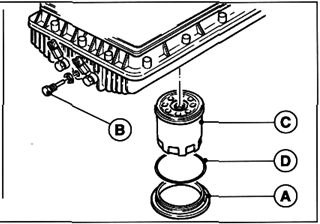
Changing the filter cartridge
and
cleaning the mesh filter
(fig. 30)
After the first 500--
1500 krn (first oil change) and then
every 10,000 km , replace
the filter cartridge as follows:
unscrew the oil drain
plug ~~B,, and drain all oil out of
the sump;
unscrew cover ~~A- using
the suitable tool (available
from your dealer);
unscrew the filter cartridge
~~C,> using the same tool
and replace it with an
original cartridge.
When refitting cover -A.,
check its oil seal ~D- and
replace it if necessary.
These operations are best
carried out by an
authorized dealer.

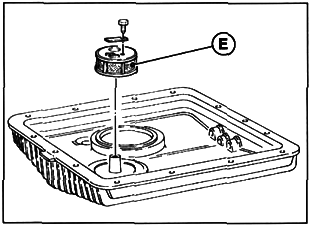
Washing the wire mesh
filter (fig. 30A)
After the first 500+1500
km, (first oil and filter cartridge change), and then every 30.000 km it
is recommended to remove the oil sump from the engine block, remove the
wire mesh filter,,Eo and wash everything in petrol; then blow the filter
with a compressed air jet. Don't forgetto fit a new sump gasket when refitting
the sump.
These operations are best
carried out by an authorized dealer.
Gearbox lubrication (fig.
31)
Checking the oil level
Check the oil level every
5000 km; the oil should be visible through the inspection window "B", located
on the right side of the gearbox.
Carry out the control
with the vehicle in a perfectly vertical position, with a warm engine;
an incorrect position could give a wrong reading.
If the oil is belowthis
leveltop upwith the recommended grade and type of oil.
Oil change
The gearbox oil should
be changed every 10.000 km. Drain the oil when the gearbox is warm as the
oil is more fluid and drains more easily.
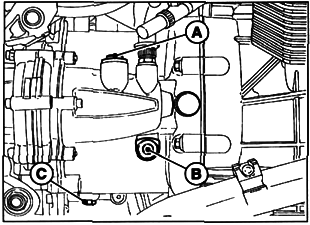
Allow the gearbox to drain
fully before filling with new oil. -A,> Filler plug. ~413~> Level plug.
~~C~, Drain plug. Oil required: 0.850 litres of ~Agip Rotra MP SAE 80W/
90-.
Rear transmission box
lubrication
(fig. 32)
Checking the oil level
Check the oil level every
5000 km; the oil should just
reach the level plug hole
-A~,.
If theoil is belowthis
leveltop upwiththe recommended
grade and type of oil.
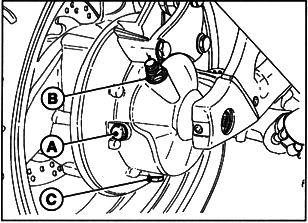
Oil change
The transmission box oil
should be changed every
10.000 km. Drain the oil
when the box is warm as the oil
is more fluid and drains
more easily.
Allow the box to drain
fully before filling with new oil.
-A,, Level plug.
~,B,, Filler plug with
exhaust.
,~C,> Drain plug.
Oil required: 0.370 litres
of which:
0.350 It. is ,Agip Rotra
MP SAE 80W/90-;
0.020 It. is -Agip Rocol
ASO/R,, or ~Wolykote type A".
Front fork oil change.
Change fork oil about
every 20,000 km or at least once
a year.
Total quantity needed:
ca. 0.800 litres of oil for
"MARZOCCH I (SAE 10)"
shock absorbers.
These operations are
best carried out by an
authorized dealer.
Greasing To grease: steering
bearings; swinging arm bearings; control rod joints; side stand fittings;
Articulated joints and needle bearing - rear driving box. Use: ogAglp
Grease 30m.
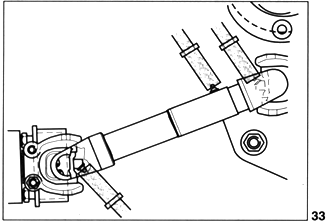
Greasing the driving
shaft(fig. 33)
The vehicle has a driving
shaft provided with greasers. The greasing operation of the 3 places shown
in figure should be made every 20000 kms or at least once every 2 years
if the number of kilometers is lower.
Types of grease to be
used
To lubricate the cardan
transmissions, only use saponifying greasers with lithium of a grade 2
consistency, 265/295 penetration and with a dropping point of about 180
*. The lubricants must not contain additives with MOS2-33
TIMING
SYSTEM
Tappet dearanceS (fig.
34)
The clearance between
rocker arms and valves should be checked and adjusted after the first 500
tol,500 krn and every 10, 000 thereafter or if the timing system becomes
excessively noisy.
Adjustments should be
made with the engine coo, ct, id the piston at TDC in the compression
phase (valves closed).
Remove the rocker box
cover and proceed as follows: I loosen nut -A,~.
2 loosen or tighten the
adjuster screw -B,, to obtain the following clearances:
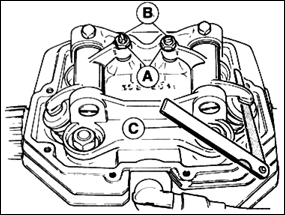
intake valve 0. 10 mm;
exhaust valve 0. 15 mm. Use a suitable feeler gauge -C,, to measure the
clear ances. Rememberthat if the clearances are greaterthan those specified,
the tappets will be noisy; if they are smaller than specified, thevalves
will notclose properlyandthis may lead to problems such as: pressure loss;
engine overheating; Valve burning, etc....
WEBER
injection-ignition system (I.A.W. 15M)
In the Weber injection-ignition
system type "alfa/N" the engine speed and the throttle position are used
to measure the quantity of air taken in; when the quantity of air is known,
measure the fuel quantity according to the strength desired. Othersensors
in the system make it possible to adjust the main operation, in special
conditions. Moreover, the engine speed and the throttle angle make it possible
to calculate the best spark advance for every operation condition. The
quantity of air taken in by each cylinder per cycle, depends on the air
density in the suction manifold, the unitary displace ment and the volume
efficiency. The volume efficiency is experimentally calculated forthe whole
engine opera tion field (rpm and engine load) and is stored in the electronic
unit. The control of the injectors, per cylinder, is'lime-sequential",
i.e. the two injectors are controlled on the basis of the suction sequence,
while the delivery can begin, for each cylinder, at any time from the expansion
phase to the suction phase, which has already begun. The timing for the
initial delivery is contained in the ECU.
Static inductive discharge
ignition which has the dwell control in the power module (incorporated
into the ECU) and has sparkadvance mapping stored in the ECU. The coils
receive the commands from the I.A.W. 15M ECU (which calculates the ignition
advance) via the power modules.
Description of the system
Fuel
circuit
Thefuel is injected intothesuction
pipeof each cylinder, upstream of the suction valve.
It includes: tank, pump,
filter, pressure adjuster, electroinjectors.
Air intake circuit
The circuit includes:
air filter, suction manifold, throttle body.
The plug for the pressure
adjuster is installed downstream of the throttle valve.
The potentiometer for
the throttle position is keyed onto the throttle shaft.
The absolute pressure
sensor (integrated in the ECU) and the air temperature sensor are installed
upstream of the throttle valve.
Control circuit
With this circuit, the
electronic unit monitors the engine conditions, the fuel delivery and the
spark advance.
It includes: battery,
ignition switch, two relays, ECU with max. pressure sensor integrated,
ignition unit, airtemperature sensor, throttle position potentiometer,
two injectors, oil temperature sensor and RPM timing sensor.
Operation phases
Normal operation
When the engine is in
standard thermal conditions, the 15M I.A.W. unit calculates the phase,
the injection time, the spark advance, only by interpolation of the corre
sponding maps memorised according to rpm and throt tle position.
The resulting amount of
fuel is delivered to the two cylinders with two subsequent injections.
The moment of the initial
delivery, for each cylinder, is determinedby means of a map that depends
on the number of revolutions.
Starting phase
When the ignition switch
is in operation, the 15M I.A.W. unit feeds the fuel pump for few moments
and detects the throttle angle and the temperature of the engine.
After starting the engine,
the unit receives the revolution and phase signals, which allow it to control
the injection and the ignition.
To facilitate the starting
phase, the essential oil is enriched in accordance with its temperature.
After the starting phase,
the ECU begins to check the spark advance.
Acceleration mode During
acceleration, the system increases the quantity of fuel delivered , in
order to obtain better handling. This condition is recognised when the
throttle angle variation reaches appreciable values: The enrichment factor
is determined according to the oil and air tem peratures.
WARNING!
To avoid damaging the
electronic ignition/
injection system, take
the following precautions:
in case of battery
removal or refitting, make sure
the ignition switch
is in the OFF 44q* position;
do not disconnectthe
battery with theengine on;
make sure the connector
cables are perfectly
eff icient;
do not carry out any
electric welding on the
vehicle;
do not use other electrical
devices to start up the
vehicle;
to prevent the ignition
systernmalfunctioning or
working inefficienctly
make sure the spark plug
wire connections (spark
plug cap) and the spark
plugs are of the recommended
type (as original
equipment);
do not carry out checks
on the plug current if the
original spark plug
caps are not fitted as this could
cause irreparable damage
to the ECU;
if installing any antitheft
devices or other electric devices, never touch the electric ignitionrinjection
system.
The carburettor setting
In the electronic injection/ ignition system (air/gasoline ratio) cannot
be al tered.
IMPORTANT! Do not tamper
with the mechanical and elec tronic components in the electronic injectionAgni
tion system. Any adjustment or maintenance work should be carried out by
one of our authorlsed dealers.

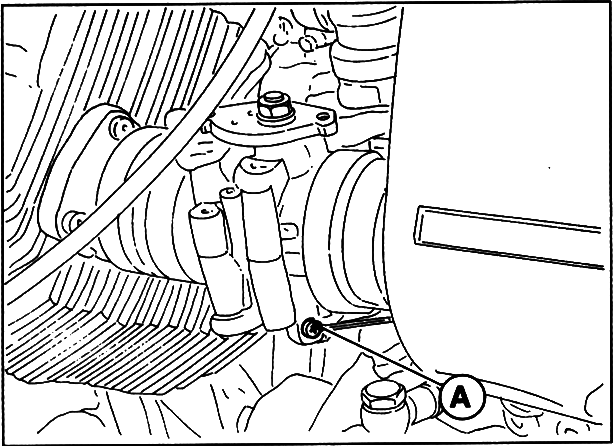
Adjusting the CO and the
idle setting
(fig. 35)
To adjust the idling speed,
turn the screw ,A- on both
throttle bodies, using
the appropriate vacuum gauge.
0 Recommended minimum
rpm for both models:
1000-- 1100 rpm.
N La valeur du CO au r6gime
de ralenti dolt 6tre 1,5%.
N.B. - The Idle setting
should be adjusted when the engine Is at running temperature.
These operations are best
carried out by an authorized dealer.
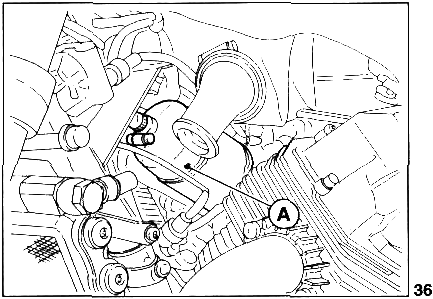
Changing the fuel filter(fig.
36 --A )
The filter is fitted with
a paper filter element~ with a surface of approx. 1200 cm2, and a filtering
power of 10 mp; this is indispensable as the injectors are highly sensitive
to foreign bodies.
The filter is fitted under
the petrol tank between the pump and the throttle body unit and on the
outer casing an arrow indicates the fuel flow direction.
Every 20,000 km this filter
should be changed.
To change the air filter,
It Is adviaW to use an authorized dealer.

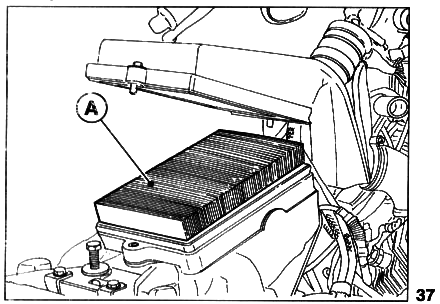
Changing the air filter
(-A~- of fig. 37) Check the air filter every 5,000 km and clean by blowing
with compressed air; change it every 10,000 km. This filter is mounted
in a special case above the engine unit, the saddle and fuel tank must
be removed in order to gain access to it. For the above operations you
are advised to contact one of our authorlsed dealers.

Spark plugs (fig. 38)
Use the following types
of spark plug: NGK BPR 6 ES
Gap between spark plug
electrodes: 0.7 mm.
Remove the spark plugs
for cleaning and checking on a regular basis.
Refit the plugs by hand
taking care not to cross thread them. They should screw in easily; it is
then recom mended to tighten them manually for some turns and to use the
special key provided, to lock them when the engine is cool.

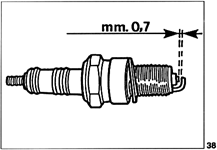
Even if used plugs appear
to be in good condition, they should be replaced every 10.000 km.
N.B. - Values lower than
0.7 mm may reduce the engine's working life.
WARNING! to prevent the
ignition system malfunction ing or working Inefficiently make sure the
spark plug wire connections (spark plug cap) and the spark plugs are of
the recommended type (as origi nal equipment).
Do not carry out checks
on the plug current if the original spark plug caps are not f itted as
this could cause irreparable damage to the ECU.
ELECTRICAL
SYSTEM
The electrical equipment
consists of the following:
Battery.
Electro-magnetically controlled
starter motor.
Generator-alternator fitted
to the front of the crank
shaft.
Fuel reserve signalling
device.
Electric cock
Headlight micro-switch.
Ignition coil.
Electronic control unit
(I.A.W. 15 M).
Phase and revolution sensor.
Voltage regulator.
Fuse box.
Electronic control unit.
Micro-switch for pump,
coils, electro-injectors.
Starter micro-switch.
Headlight.
Tail light.
Direction indicators.
Engaging switch for connected
devices.
Light direction indicator,
horn and headlamp flasher
switches.
Intermittence.
Starter and stop device.
Two-tone horn.
Electric horns - Horn
microswitch.
Warning lights on instrument
panel for: neutral indi
cator (green), dippedlights
on (green), oil pressure
(red), main beam (blue),
generator (red), fuel reserve
(orange), direction indicators
(green).
Battery
The battery has a 12V
voltage, a 13Ah capacity and is
charged by the alternator.
To gain access to the battery,
the saddle must be removed.
The battery is the hermetic
type (maintenance-free) and
does not need to be checked
Instructions for recharging
To recharge the battery, use a constant voltage charger set to 14.7 - 1
5V at 25'C.
WARNING
- Contains toxic materials
(Pb and H2SOJ
· Extremely high
current, avoid short circuit.
· DO NOT charge
in a gas tight container.
· Sealed Lead Battery.
Must be recycled or disposed
of properly.
These operations are best
carried out by an authorized dealer.
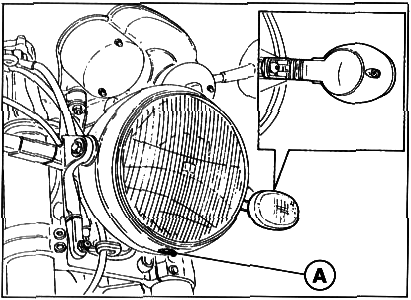
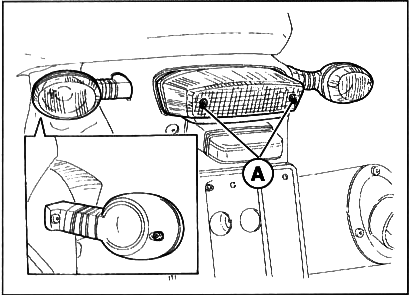
Tail light (fig. 40) Unscrew
the screws "A" which fasten the reflectortothe light body; at the same
time, press the bulb inward while rotating it and slide it out from the
bulb holder.
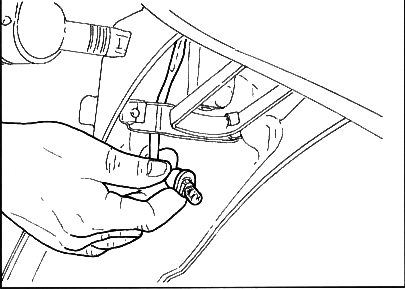
Number-plate light (fig.
41) Extract the bulb holder as indicated and replace the bulb.
Front and rear direction
indicators (figs. 39-40) Undo the screws ~D,, which fix the reflector to
the direction indicator unit. To remove the bulb from the bulb holder,
press it in and turn. N.B. - Do not overtighten the reflector retain ing
screws as this will break the reflector.
Odometer - revolution
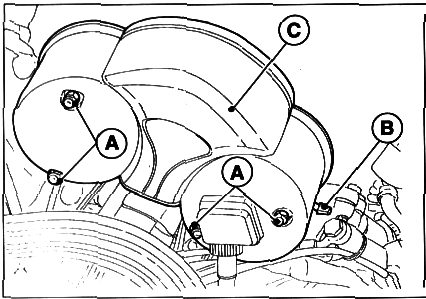
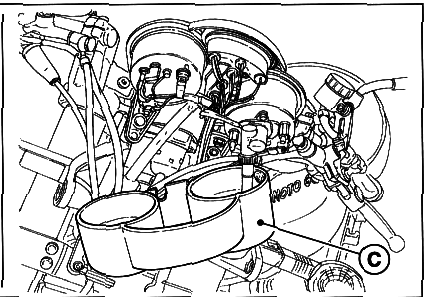
counter - instrument panel warning lights (Fig. 42) Detach the front light;
Remove screws ~A-; Extract the reset pin ~113,,; Detach the lower instrument
panel cover ,C-; Extract the lamp holder and replace the lamp.

Adjusting the headlight
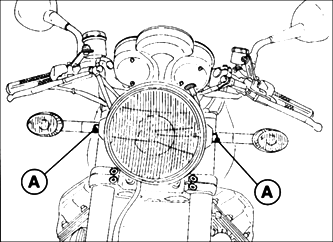
beam (fig. 43)
The headlight beam should
always be kept positioned at the correct height to ensure good visibility
and to avoid dazzling oncoming traffic. To position it vertically orien
tation, loosen the two screws -A,, that fix the headlight and move it manually
upwards or downwards to the prescribed height.
Bulbs
Headlight:
High and low beams 60/55
W
Side/parking lights 4
W
Tall light:
Number plate, dipped,
stop light 5/21 W
Direction Indicators low
Tachometer warning lights
3 w
Instrument panel warning
lights 1.2 W