

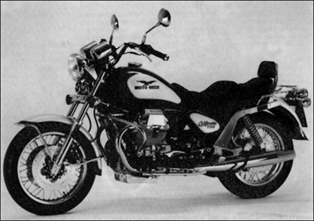
MAIN MODEL WITH
CARBURATOR
Specifications
Frame
and engine numbers
Instruments
and controls
Cleaning
and storing
Cleaning
the windscreen (if mounted)
Riding
your motorcycle
Running-in
Break-In
Maintenance
and adjustments
Removing
the wheels
Maintenance
schedule
Lubrication
Fuel
system
Valve
gear
Electronic
ignition
Electrical
equipment
Variations
for "Electronic Injection" model
TABLES
Fluid
Quantities (Table 1)
Break-In
(Table 2)
Maintenance
Schedule 1000-15000 mi. (Table 3a)
Maintenance
Schedule 18000-30000 mi. (Table 3b)
Carburettor
settings (table 4)
ILLUSTRATIONS
Frame
number (fig. 2a)
Engine
number (fig. 2b)
Instrument
panel (fig. 3)
Horn
button, passing and direction indicators (fig. 4)
Starter
button and engine stop switch (fig. 5)
Gear
change pedal (fig. 6)
Fuel
filler cap (fig. 7)
Fuel
taps (fig. 8)
Fuse
box (Fig. 9)
Steering
damper (Fig. 10)
Side
bags and top-case (optional) (Fig. 11)
Seat
lock latch location (Fig. 12a)
Seat
lock key location (Fig. 12b)
Helmet
holder (Fig. 13)
Side
stand (fig. 14)
Adjusting
the clutch lever (fig. 15)
Front
brake master cylinder reservoir (fig. 16)
Rear
brake master cylinder reservoir (fig. 17)
Adjustable
telescopic fork (fig. 18a)
Adjustable
telescopic fork (fig. 18b)
Adjusting
the rear shock absorbers (fig. 19)
Adjusting
the steering (fig. 20)
Front
wheel (fig. 21)
Rear
wheel (fig. 22)
Checking
the oil level (fig. 23)
Changing
the filter cartridge and cleaning the mesh filter (fig. 24)
Checking
the oil level (fig. 25)
Rear
transmission box lubrication (fig. 26)
Front
fork lubrication top nut (fig. 27a)
Front
fork lubrication drain plug (fig. 27b)
Carburettors
(fig. 28)
Changing
the air filter (fig. 29)
Valve
clearances (fig. 30)
Spark
plugs (fig. 31)
Replacing
bulbs (fig. 32)
Tail
light (fig. 33)
Instrument
panel (fig. 34)
Adjusting
the headlight beam (fig. 35)
Wiring
Schematic - California 1100
Wiring
Schematic Key - California 1100
Wiring
Diagram - Digiplex
Wiring
Diagram Key - Digiplex
Fuses
(fig. 36)
Fuel
filter replacement (fig. 37)
Wiring
Schematic - California 1100i
Wiring
Schematic Key - California 1100i
SPECIFICATIONS
(main model)
return to contents
EngineEnginereturn to SPECIFICATIONS
Valve gear
Carburettors
Lubrication
Generator / Alternator
Ignition
Starter
Transmission
Clutch
Primary drive
Gearbox
Final drive
Frame
Suspension
Wheels
Wheels
Tires
Brakes
Dimensions and weight
Performance
Fluid Quantities
Valve
gear return to SPECIFICATIONS
O.H.V. push rod
operated rocker arms
Carburettorsreturn
to SPECIFICATIONS
2 Dell'Orto carburettors
PHIF 36 DD (right) and PHIF 36 DS (left)
Lubricationreturn
to SPECIFICATIONS
Pressure fed by
gear pump
Wire mesh and cartridge
filters on oil sump
Normal lubrication
pressure 3.8-~-4.2 kg/cm2 (pressure valve on oil sump).
Low oil pressure
sensor (electrical) on crankcase.
Generator
/ Alternator return to SPECIFICATIONS
On front of crankshaft.
Output power: 350W at 5000 rev./min. (14V - 25A).
Ignitionreturn
to SPECIFICATIONS
"MAGNET[ MARELLI
- DIGIPLEX" Inductive discharge
digital electronics.
Spark plugs: NGK
BPR 6 ES.
Spark plug gap:
0.7 mm
2 ignition coils
mounted on frame.
Starterreturn
to SPECIFICATIONS
Electric starter
motor 12V-1,2 Kw with electromagnetic ratchetcontrol.
Ring gearon the
flywheel. START push button on right handlebar.
Transmissionreturn
to SPECIFICATIONS
Clutchreturn
to SPECIFICATIONS
Dry, twin driven
plates. Located on engine flywheel.
Clutch lever on
left handlebar.
Primary
drive return to SPECIFICATIONS
By gears, 1:1.235
(Z=l 7/21).
Gearboxreturn
to SPECIFICATIONS
5-speed, front engaging,
constant mesh. Incorporated Cush drive
Control pedal on left side of machine. Gear ratios:
Ist 1:2 (Z=14/28)
2nd 1: 1.3889 (Z=
18/25)
3rd 1:1.0476 (Z=21/22)
4th 1:0.8696 (Z=23/20)
5th 1:0.7500 (Z=28/21)
Final
drive return to SPECIFICATIONS
Cardan shaft with
gears Ratio: 1:4,125 (Z=8/33)
Overall gear ratios
(engine-wheel)
1 st gear = 1:10,1912
2nd gear= 1: 7,0772
3rd gear = 1: 5,3382
4th gear = 1: 4,4309
5th gear = 1: 3,8217
Framereturn
to SPECIFICATIONS
High tensile stress
modular duplex tubular cradle.
Suspensionreturn
to SPECIFICATIONS
Front: -MOTO-GUZZI
patented- hydraulic telescopic forks
springs load and
dumping effect adjustable.
Rear: Oscillating
fork with two adjustable hydraulic suspensions
in the hydraulic
brake in extension and adjustable springs in the preloading.
Wheelsreturn
to SPECIFICATIONS
To the spokes.
Rim sizes:
- Front: 18"x2,50
- B40 - TC e DOT
- Rear: 17"x3,50
- 40 - TR e DOT.
Tiresreturn
to SPECIFICATIONS
- Front: 110/90
- 18 - 61 H/61 V/61 VB
- Rear: 140/80 -
17 - 69H/69V/69VB
Brakesreturn
to SPECIFICATIONS
Front: floating
disc with fixed caliper, twin brake cylinder.
Brake lever on right
handlebar. Independent hy
draulic circuit
for rear brake.
- 0 disc 300 mm;
- 0 brake cylinder
38 mm;
- 0 master cylinder
11 mm.
Rear: floating
disc with f ixed caliper, twin brake cylinder.
Brake pedal on centre-right
of motorbike;
- 0 disc 270 mm;
- 0 brake cylinder
38 mm;
- 0 master cylinder
15.875 mm.
The rear brake is
connected by a hydraulic circuit to the
left front brake;
the left front brake has the same
dimensions as the
right front brake controlled by the
brake lever.
Dimensions
and weight return to SPECIFICATIONS
Wheelbase 1,560
m
Overall length 2,355
m
Overall width 0,815
m
Height (without
screen) 1,150 rn
Driver's seat height
0,765 m
Weight (dry) 245
kg
Performancereturn
to SPECIFICATIONS
Max. speed without
accessories with one rider: 190 Krn/h.
Fuel consumption:
5,4 It/i 00 km (CUNA standards).
N.B. - On request
the motor vehicle can be equipped with a windshield
which allows comfortable
driving, and large capacity removable sidebags.
These items do however
after the aerodynamic features of the bike;
it is advisable
therefore not to exceed 130 kph especially when the bike
is fully loaded.
Fluid Quantities return to SPECIFICATIONS
FRAME
AND ENGINE NUMBERS
return to contents
The frame number
is stamped on the downtube; this number is entered
in the motorcycle's
log-book and is thus usedto identify the vehicke for
legal purposes.
The engine number is stamped on the crankcase.
Spare Parts
Always use approved
aMoto Guzz! Original Sparesm only when replacing
or repairing parts.
Useof spareswhich are not approved will invalidate
warranty rights.
INSTRUMENTS
AND CONTROLS
return to contents
Instrument panel
1 Key switch with following positions:
Position <<O>> vehicle stopped, keys can be removed.2 Speedometer and mileometer.
(no contact)
Position <<A>> vehicle can be started. All circuits on. Key
cannot be removed;
Position <<B>> vehicle stopped. With the switch <<A>> (f ig. 5)
in position <<P>> the parking lights are on and the key
can be removed.
- Position <<Switch <<A>> (lights) (fig. 4)>> lights off.
- Position <<>> parking lights on.
- Position <<>> twin-filament headlamp on.
With switch <<A>> (lights) of fig. 5 in position <<H>>.
- Position <<LO>> dipped beam.
- Position <<HI>> main beam.
Horn button,
passing and direction indicators (fig. 4)
These are mounted
on the left handlebar:
Push-button <<B>>(Horn)
sounds the electric horn when
pressed.
Push-button <<C>>(passing)
flashing light control.
Push-button <<C>>
(turn):
- position <<R>> for right turn signals control.
- position <<L>> for left turn signals control.
- press the switch to disconnect flashers.
Starter button
and engine stop switch (fig. 5)
These are mounted
on the right handlebar.
With the key <<1>>
, in f ig. 3 (position <<ON>>), the vehicle
is
ready for starting.
To start the engine:
- check that switch <<B>> is in position (run);Once the engine has stopped, turn the key switch
- pull the clutch lever in to disengage the clutch fully;
- if the engine is cold, put the <<CHOKE>> control <<E>>
in the starting position <<1>> - (see fig. 4);
- press the starter button <<C>> (start).
To stop the engine in case of emergency:
- turn the switch <<B>> to position (off).
N.B. Before start, put switch <<B>> in (RUN) position.
Throttle twist
grip (<<D>> in fig. 5).
The throttle control
is on the right handlebar; turning the
twist-grip towards
the rider opens the throttle, turning it
away from the rider
closes it.
Clutch lever
(<<F>> in fig. 4)
This is on the left
handlebar and is only to be used when
starting or changing
gear.
Brake lever, r/h
front brake (<<E>> in fig. 5)
This is on the right
handlebar and controls the master
cylinder of the
right front brake.
<<CHOKE>>
control
(<<E>> in fig. 4)
The <<CHOKE>>
is on the left handlebar and is used f cold starts.
- Position <<1>> CHOKE on; starting position.Brake pedal for left front brake and
- Position <<2>> CHOKE off; engine running.
Gear change pedal (fig. 6)
This is a double
rocker arm type, situated on the left of
the motorcycle:
- 1 st gear: push front pedal down;Before changing gear disengage the clutch fully.
- 2nd, 3rd, 4th, 5th gears: push rear pedal down;
- neutral: between 1 st and 2nd gears.
Fuel filler cap (fig. 7)
To open, turn the
key anti-clockwise, and press the
push-button <<A>>.
N.B. - Fuel spillage
caused during refuelling should
be cleaned immediately
to prevent damage to the
fuel tank paintwork.
Fuel taps (fig. 8)
They are located
under the fuel tank on the rear part.
The levers of FUEL
cocks have two positions:
<<ON>> open:
lever arrow upwards.
<<OFF>> close:
lever arrow horizontal.
A <<reserve>>
position is not indicated on the knob but a
warning light on
the instrument panel lights up to indi-
cate that the fuel
tank is on reserve.
N.B. - In the
version with carburetors, do not leave
the fuel taps
open when the motor is off since the
the fuel could
flow into the motor.
In the injection
model, it is recommended to always
leave the fuel
taps open.
Fuse box (Fig. 9)
This is located on
the right side. To enter it is necessary
to remove the side
cover and possibly the front saddle.
The terminal board
has 4, <<15 Amp>> fuses.
Before changing
a burnt fuse, trace and repair the
cause of the trouble.
Fuse <<1>>: hazard warning lights.
Fuse <<2>>: side lights, instrument panel light, direction
indicators.
Fuse <<3>>: stop light for the rear pedal, horn switch,
motor starter.
Fuse <<4>>: warning lights (generator, oil pressure, neutral,
main beam, dipped beam, passing, stop light for
the front lever, regulator.
Steering damper
(Fig. 10)
It is fitted between
the frame and steering joke on the left
hand side.
To harden or loosen
the steering, turn in or out the knob
<<A>>.
Side bags and top-case (optional) (Fig. 11)
To release the sidebags
and the top-case from the
supports, pull lever
<<A>> of the clamping device after
having released
the lock using its key. To open the lids,
lift lock <<B>>
after having released it with its key.
N.B. - The maximum
load for each side bag is 22 lbs. (10
kg.); loads should
be equally distributed between
the two bags.
The maximum load
allowed for the top-case Is 11 lbs. (5 kgs.).
Seat lock (Fig. 12)
The driver's saddle
is clamped by device <<A>> operated
by means of a flexible
transmission by the <<B>> lever,
inserted in the
helmet carrier device <<C>>. To unclamp
the saddle it is
necessary to pull lever <<B>> downward
after having released
it by turning helmet carrier lock
<<C>>. To
clamp the saddle, it must be placed in its seat
on the frame, pressed
on, then lock lever <<B>>. The
passenger's seat
is fixed in place.
Helmet holder (Fig. 13)
The helmet can be left with the motorcycle, using the helmet holder with lock <<cC>>.
N.B. - never leave
the helmet in the holder when the
motorcycle is
running, as it may interfere with the
moving parts.
Steering lock
(<<A>> in fig. 13)
To lock:
- Turn the handlebar full lock to the right.To unlock: Insert the key in the lock, turn anti-clockwise, release
- Insert the key in the steering lock; turn the key anit-
clockwise then push down and turn clock-wise; release
and remove the key.
Side stand (<<A>> in fig. 14)
The motorcycle is
fitted
with a side stand for parking.
When the side stand
is in use (i.e. in the out position) it
activates a microswitch
<<B>> controlling a relay which
disables to the
starter motor; it is therefore not possi ble
to start the vehicle
with the side stand in use.
CLEANING
- STORING
return to contents
Cleaning
Preparations
for washing
Before washing the
vehicle the following parts should be covered with an impermeable material:
the rear part of the silencers; the clutch and brake levers and pedals,
the throttle twist-grip and the ignition key switch.
Washing
Avoid spraying water
too much pressure on the instru-
ments and the front
and rear hubs.
Drying
Remove the protective
coverings.
Thoroughly dry the
vehicle.
Test the brakes
before using the vehicle.
N.B. - To clean
the painted parts of the engine unit
(engine, gearbox,
transmission box, etc.) the fol-
lowing products
may be used: diesel oil, petrol or
water-based neutral
detergents for car cleaning.
These products
should be washed off immediately
with water; do
not use waterat high temperatures or
pressures.
Storage
If the vehicle is
to remain idle for a considerable period
of time (e.g. for
the winter period) it should be stored in
the following way:
- clean the vehicle thoroughly;CLEANING THE WINDSCREEN (if mounted)
- empty the f uel tank and the carbureftors; if left for-a
long time, the fuel would evaporate;
- remove the spark plugs and put a few drops of SAE
30 oil into che cylinder. Turn the crankshaft for a few
revolutions and then replace the spark plugs;
- reduce the tire pressures by 20%;
position the vehicle so that its wheels are not
touching the ground;
- smear a layer of oil on unpainted parts to prevent
rust;
- remove the battery and store in a dry place away
from the direct sunlight andwherethere is notdangerof
frost; check the battery charge once a month;
- cover the vehicle but in such a way that the air can
circulate.
The windscreen can
be cleaned using most of the
soaps, cleaners,
waxes and polishes commercially
available for glass
and plastic.
The following precautions
should be taken:
- do not wash or polish the windscreen in direct or
strong sunlight or when temperatures are high;
- under no circumstances use solvents, lyes or similar
products;
- do not use abrasive substances, pumice, sand/
emery paper, files, etc.;
- wash all dust and dirt away before polishing. Small
superficial scratches can be removed using a mild
polish;
- paint or sealing compound can be removed before
harden by using diesel, isopropylic alcohol or butyl
cellosolvent (do not use methyl alcohol);
- use soft cloths, sponges, chamy leathers or cotton
wool; do not rub too hard. Do not use paper towels or
man-made fibre cloths as they tend to scratch the
windscreen.
- Deep scratches cannot be removed by hard rubbing or
the use of solvents.
RIDING
YOUR MOTORCYCLE
return to contents
Preliminary checks
Check:
- that there is sufficient fuel in the tank;
- that the engine oil level in correct;
- the ignition key is in position <<A>> (see fig. 3);
- that the following warning lights are on;
- red warning lights: oil pressure and generator;
- green warning light: <<NEUTRAL>> indicator;
- that the <<CHOKE>> control is in the starting position
(if the engine Is cold) (<<1>> fig. 4).
Cold start
Once the preliminary
checks are complete the vehicle
can be startted.
Turn the throttle twist-grip until it is 1/4
open, disengage
the clutch fully, check that the switch
<<B>> (fig.
5) is in the run position; press the starter button
<<C>> (fig.
5).
When the engine
has started, allow the engine to idle at
low revs for
a few minutes (in cold weather) or for a few
seconds (in warm
weather) before switching the
<<CHOKE>>
control to the run (off) position (<<2>> in fig.
4).
If the <<CHOKE>>
is left in the start position (<<1>> fig. 4)
when the vehicle
is being used, carburation will
be faulty,fuel
consumptionwill begreatly increased
and there will
be a risk of seizing the engine caused
by the washing
of the cylinders by the excess fuel.
Caution!
-
If the green <<Neutral>> warning light does not
come on when the
ignition switch is on (see <<A>> in fig. 3)
this means that
a gear is engaged; starting the vehicle
in this condition
could be dangerous.
Before starting,
always check that the engine is in
neutral.
Warm start
Follow the same
procedure as that for the cold start but
without the <<CHOKE>>
control in the start position
(<<1>> fig.
4) otherwise the mixture will be too rich.
ATTENTION!
-
The
starter motor should not be
operated for
more than 2-5 seconds; if the engine
doesn't start,
wait for 10 seconds before the following
starting operation.
Anyway act on the starter button
(START) only
with the engine completely stopped.
On the road
To change gear,
shut the throttle, disengage the clutch
fully and engage
the next gear; then engage the clutch
gradually while
opening the throttle.
The gear change
pedal should be operated firmly and
surely.When changing
down use the brakes gradually
and close the throttle
gradually to avoid over-revving the
engine.
Stopping
Close the throttle
and use the brakesjust as the vehicle
is about to stop
disengage the clutch. These three
operations should
be carefully coordinated to maintain
full control of
the vehicle.
When slowing down
in normal conditions, use the
gearbox to provide
engine braking to slow the vehicle;
take care not to
over-rev
the engine. Use the brakes
(especially the
right front brake) with particular care
when roads are slippery
or wet.
To stop the engine,
turn the ignition switch until <<O>>
(see fig.
3).
in the model
with carburetors, do not forget to turn
off the fuel
taps.
Parking
On badly lit roads,
leave the parking lights on.
Turn the ignition
switch until <<B>> (see fig. 3); turn the
light switch <<A>>
(fig. 5) to position ,<<P>>; remove the
ignitionand lockthesteering
(see <<Steering lock>> fig. 13).
RUNNING-IN
return to contents
The recommendations
below should be followed when
running-in:
- Before riding,
run the engine at low revs until it has
warmed up.
- Do not exceed the
rpm shown in the table; it is also
advisable to run
the engine at varying speeds rather
than at a constant
speed.
- Before stopping
reduce the speed gradually to avoid
subjecting components
to sudden changes in tempera-
ture.
- Remember that components
need several thousand
kilometers before
they are properly bedded in; care
taken in this period
will ensure prolonged vehicle life.
After the first
500~1500 km
- Change the engine
oil.
Should the oil
level drop to the minimum level
before the first
500+1500 kilometers have been
completed then
carry out a complete oil change
rather than just
topping up. Recommended oil:
-Agip 4T SUPER
RACING SAE 201&150-~
- Check that all nuts and bolts are tightened.
- Check rocker clearance.
- Check the ignition timing.
- Check tire pressures.
| Kilometers |
|
| From 0 to 1000 |
|
| From 1000 to 2000 |
|
| From 2000 to 4000 |
|
MAINTENANCE
AND ADJUSTMENTS
return to contents
Adjusting the clutch lever (fig. 15)
There should be 3~4
mm of free play at the lever; turn
the adjuster screw
<<A>> to obtain the desired play.
Play can also be
adjusted on the cable adjuster <<B>>
located on the right
side of the gearbox. First loosen the
lock nut <<C>>
and then adjust.
Adjusting the
front brake lever (fig. 16)
There should be
a certain clearance between the pump
float and the tip
of the control lever. This play can be
adjusted by turning
adjustment screw <<C>>.
Checking brake
pad wear
Check brake pad
thickness every 3000 mi. (5000 km):
- new pads 0.35
in. (mm 9);
- wear limit approx.
0.24 in. (mm 6).
If the pads are
below the wear limit they should be
changed. It is not
necessary to bleed the brakes when
new pads have just
been f ifted; pumping the brake lever
a few times will
return the caliper pistons to their normal
position.
When changing the
pads also check the flexible hoses;
if damaged they
should be replaced immediately.
N.B. - Treat new
brake pads with moderation for the
first 60 mi.
(100 km) until they are properly bedded in.
Checking brake
disks
The brake disks
must be perfectly clean, with no oil,
grease or other
dirt on them. They should also show no
signs of scoring.
The torque wrench
setting of the screws that fix the disk
to the hubs is 2.21~2.46
ft. lbs. (3~3.2 kgm.)
Checking and changing
the brake
fluid in the
master cylinder reservoir
(figs. 16
& 17)
To ensure efficient
operation of the brakes:
1 Make frequent
checks of the fluid level in the front
(<<A>> in
fig.
16) and rear (<<H>> in fig. 17) reservoirs.
The
level should always
be above the <<Minimum>>, mark on
the reservoirs.
2 Top up
the brake fluid when necessary or at regular intervals.
Only use recommended
brake fluid in sealed containers
for topping up.
Fluid
containers should only unsealed
a moment before
they are about to be used.
3 The fluid
in the brake should be changed completely
every 15.000 km
or at least once a year.
To ensure efficient
braking there should be no air
bubbles in the brake
circuit; long lever travel, or a
spongy brake lever
response indicates that there are air
bubbles in the brake
circuit.
When flushing the
circuit only use fresh brake fluid.
Never use alcohol
for flushing or compressed air
for drying; we
recommend trichloroethylene for
metal parts.
Never use mineral
oils or greases for lubricating parts;
if no suitable lubricant
is available then rubber and metal
parts can be lightly
greased with brake fluid.
Recommended brake
fluid:
<<Agip brake Fluid - DOT4>>.
These operations
are best carried out by a Moto-Guzzi dealer.
Adjusting the brake pedal of rear and left-hand front brakes (fig. 17)
Check the play between
the master cylinder actuator
and the brake rod
as follows:
- place a feeler
gauge <<G>> between the cylinder actuator
and
the brake rod, the gap between the two
parts
should be 0.05~0.15 mm.
Turn
the eccentric screw <<A>> to obtain the desired gap;
- If the gap is
not correct, remove the split pin, remove
the
pin, unscrew the lock nut <<B>> and then screw or
unscrew
the fork <<C>> to obtain the desired position for
the
brake pedal <<F>>; replace the brake rod retaining pin
and
the split pin.
Now
undo the lock nut <<E>> and adjust the lever return
stop
screw <<D>>.
Bleeding the brake
system
The brake system
requires bleeding when there are air
bubbles in the system
and when the travel of the brake
pedal and lever
becomes long and spongy.
This operation
is best carried out by a Moto-Guzzl dealer.
Adjustable telescopic fork (fig. 18a and 18b)
This motorcycle is
equipped with a new hydraulic tel-
escopic fork MOTO
GUZZI with separate adjustment of
springs pre-loading
and of dampers operation. To ad-
just springs pre-loading,
turn nut <<A>> through a 32 mm
wrench. Turning
it clockwise the spring pre-loading is
reduced; turning
it counterclockwise, the pre-loading
increases.
To adjust the damper
hydraulic operation, turn knob
<<B>>.
Turn it clockwise,
the hydraulic operation decreases;
turning it counterclockwise,
it increases.
Do not force
the knob <<B>> and the nut <<A>> to the
extreme positions.
N.B. - It's Important
that spring pre-loading and
damper operation
are equally adjusted on both
forks prongs,
(equally turn both pre-loading ad-
justment nuts,
beginning from end of stroke posi-
tion, as well
as the two hydraulic operation adjust-
ment knobs).
To avoid the
damaging of the shock-absorbers
when riding on
uneven roads, do not adjust them
(knob <<B>>)
In position of maximum braking.
Adjusting the rear shock absorbers (fig. 19)
The motorcycle is
equipped with shock absorbers with
separate adjustment
of the springs pre-loading and the
action of the dampers.
To adjust the springs
pre-loading, turn ringnut <<A>>
manually.
Rotating in a counter-clockwise
direction (looking down
from above) the
preloading of the springs is increased;
vice versa, rotating
in a clockwise direction, it isreduced.
To adjust the hydraulic
braking of the suspension, turn
adjustment control
knob <<B>>.
According to needs
and the load on the motorcycle,
there are several
setting positions; from position <<1>>
very soft (minimum
damping) to position <<5>> very hard
(maximum damping).
The filling and
operating pressure of the rear shock
absorbers is 72.5~101
psi. (5~7 BAR), to be checked using the correct
gauge; for filling,
use nitrogen or dehydrated air.
The shock absorber
pressure should be checkedby an
authorized Moto-Guzzi
dealer.
N.B. - Each shock
absorber should have the same
spring loading
and damper setting as the other
shock absorber
to ensure maximum stability of the
vehicle.
Adjusting the steering (fig. 20)
To ensure safe riding,
the steering should be adjusted
to allow free movement
of the handlebars without any
play.
- Remove bar locking plate <<D>>.This operation is best carried out by a Molo-Guzzi
- loosen the steering head fixing bolt <<A>>;
- undo the steering head nut <<B>>;
- turn the adjuster nut <<C>> to take up any play.
When play has been adjusted tighten the nut <<B>> and
the steering head fixing bolt <<A>>.
REMOVING
THE WHEELS
return to contents
Front wheel (fig. 21)
Remove the wheel as follows:
- place the machine securely on its centre stand,INSTRUCTIONS FOR VEHICLES EQUIP-
place a support underthe engine base in orderto lift the
wheel from the ground;
- undo the bolts <<A>> holding the brake calipers to the
fork legs and remove the calipers complete with hoses;
- unscrew the spindle retaining wheel nut <<C>>;
- loosen the pinch bolts ,<<E>>
- remove the wheel spindle <<F>> paying attention to
the position of the spacers<<D>> then remove the wheel;
- refitting the wheel is the reverse of the above proce-
dure; care should be taken to fit the spacers in the
correct position; pump the brake lever and pedal a few
times to return the caliper pistons to their normal posi-
tion.
At each maintenance
control, check for integrity and
tension of the wheel
spokes.
A wrong spoke tension
or the breakage of one or more
spokes may affect
the wheel, thus compromising the
vehicle safety and
stability.
Always observe the
maximum load indications provided
on the official
circulating papers.
Rear wheel (fig. 22)
To remove the rear
wheel from the swinging arm and
from the final drive
box proceed as follows:
- place the machine securely on its centre stand;Refitting the wheel is the reverse of the above procedu-
- remove the left side silencer;
- undo the spindle nut <<A>> and washer <<B>>on the
final drive box side;
- loosen the pinch bolt <<D>> on the swinging arm;
slide the spindle <<C>> out from the final drive box, the
hub, and the swinging arm;
- remove the plate assembly complete with caliper
<<E>> from the torque arm and fix this assembly to the
frame;
- lean the machine to the right just enough to be able
to disengage the wheel from the swinging arm and the
final drive box and remove.
Wheel
balancing
To improve stability
and decrease vibrations at high
speed, the wheels
must be well balanced.
This operation is
best carried out by a Moto-Guzzi dealer.
TIres
TIres are among
those machine components which
require regular
checking.
Machine stability,
rider comfort and safety all depend on
good tIre condition.
Do not use tires
with less than 0.08 in. (2 mm) of tread.
Incorrect tire pressures
can cause instability and ex-
cessive tyre wear.
Tire pressures:
- ront wheel: with one or two riders 33.36 psi. (2.3 BAR.)These pressures are for normal touring use. For
- rear wheel: with one rider 36.26 psi. (2.5 BAR)
- rear wheel: with two riders 42.06 psi. (2.9 BAR)
Tire fitting
This machine isfitted
with cast, aluminum alloy rims; even
though these are
very strong they can be damaged both
aesthetically and
mechanically by the use of incorrect
tools when removing
and fitting tyres. Tyre levers should
not have sharp edges
or ribbing in those places where
they come into contact
with the rim; lever contact
surfaces should
be smooth and edges should be
rounded.
Use of a suitable
commercially available lubricant facili-
tates tyre removal
and fitting therefore making strenu-
ous use of the levers
unnecessary. It is important to
ensure that the
tyre beads settle properly into the centre
rim groove.
Some tires have
an arrow molded on the sidewall, in
these cases the
tires should be fitted as follows:
- rearwheel: arrowpointing in thedirection of rotation;
- front wheel: arrow pointing against the direction of rotation.
N.B.-These
instructions should befollowed unless
otherwise directed
by the tyre manufacturer.
MAINTENANCE
SCHEDULE
return to contents
LUBRICATION
return to contents
Engine lubrication
Checking the
oil level (fig. 23)
Check the crankcase
oil level every 500 km; the oil
should reach the
<<Max>> mark on the dipstick,<<A>>. If the
oil is below this
level, top up with the recommended type
and grade of oil.
The oil level
check should be carried out after the
engine has run
for a few minutes: the dipstick plug
<<A>> should
be screwed fully home.
Oil change
(figs. 23 & 24)
The oil should be
changed after the first 500~1500 km
and every 5000 km
thereafter. Change the oil when the
engine is warm.
Allow the sump to
drain fully before filling with new oil.
<<A>> Oil
filler plug with dipstick (fig. 23);
<<B>> Oil
drain plug
Oil required: 3
litres of <<Agip 4T SUPER RACING
SAE20WI50>>.
Changing the filter
cartridge and
cleaning the
mesh filter (fig. 24)
The filter cartridge
<<A>> should be changed every 15,000
km (every 3 oil
changes) as follows:
- unscrew the drain plug <<B>> and allow the sump oil toDo not forget to fit a new sump gasket when refitting the
drain off fully;
- undo the screws and remove the sump cover <<C>>
from the crankcase: this assembly includes the filter
cartridge <<A>> the mesh filter <<D>> and the oil pressure
valve <<E>>.
- When changing the filter cartridge <<A>> it is also a
good idea to remove the mesh filter <<D>> and wash it in
petrol; dry by blowing with compressed air. Blow the oil
ducts in the sump out with compressed air and refit the
mesh filter.
Gearbox lubrication
Checking the
oil level (fig. 25)
Check the oil level
every 3000 mi. (5000 km); the oil should just
reach the level
plug hole <<B>>.
If the oil is below
this level top up with the recommended
grade and type of
oil.
Oil change
(fig. 25)
The gearbox oil
should be changed every 6000 mi. (10,000 km).
Drain the oil when
the gearbox is warm as the oil is more
fluid and drains
more easily.
Allow the gearbox
to drain fully before filling with new oil.
<<A>> Filler
plug.
<<B>>Level
plug.
<<C>> Drain
plug.
Oil required: 0.79
qts. (0.750 litres) of Agip Rotra MP SAE 80W/90.
Rear transmission box lubrication (fig. 26)
Checking the oil
level
Check the oil level
every 3000 mi. (5000 km); the oil should just
reach the level
plug hole <<A>>
If the oil is below
this level top up with the recommended
grade and type of
oil.
Oil change
The transmission
box oil should be changed every
6000 mi. (10,000
km). Drain the oil when the box is warm as the oil
is more fluid and
drains more easily.
Allow the box to
drain fully before filling with new oil.
<<A>> Level
plug.
<<B>> Filler
plug.
<<C>> Drain
plug.
Oil required:
8.45 fl. oz. (0.250 litres) of which:7.78 fl. oz. (0.230 Iitre) is <<Agip Rotra MP SAE 80W/90>>
and
0.68 fl. oz. (0.020 litre) is <<Agip Rocol ASO/R>> or <<Molykote type A>>.
Front fork
lubrication (fig. 27)
To change the fluid
in the front forks proceed as follows:
- place the machine
on the centre stand, dismantle
the
handlebar clamping plate and the instrument panel;
- loosen the side
clamp bolts,,C- holding the steering
head
and the fork together;
- undo the top nut
<<B>> remove the drain plug <<A>>;
- push the front
of the machine downwards, this will
force
the top nut <<B>> out of the tube since the top nut is
attached
to the damper assembly;
- replacethe drain
plug <<A>> and fill the fork with 70 cc
of
<<Agip ATFI ID>> pour the fluid into the space
between
the fork and the damper assembly;
- release the front
of the machine, refit the top nut -13
and
then tighten the side clamp bolts. Repeat the whole
operation
for the other fork leg.
Greasing
To grease:
- steering bearings;
- swinging arm bearings;
- control rod joints;
- centre/side stand
fittings.
Use: Agip Grease
30.
FUEL
SYSTEM
return to contents
Carburettors (fig. 28)
2 Dell'Orto carburettors, PHF 36 DID (right) and PHF 36 IDS (left).
Carburettor controls
- throttle twist
grip on right handlebar;
- <<CHOKE>>
cold start control lever, <<E>> (fig. 4)
on
the left handlebar.
<<CHOKE>>
control lever positions:
<<1>> cold
engine
start position
<<2>> choke
off, engine running.
Carburettor settings
| Diffuser | 0 36 mm |
| Throttle valve | 60/3 |
| Spray nozzle | 266 AR |
| Main jet | 130 |
| Idle jet | 50 |
| Starting jet | 70 |
| Tapered needle | K 18 (2nd notch) |
| Float | 8.5 gr. |
| Idling screw: | opening from 1 3/4 to 2 3/4 turns. |
Adjusting the
<<CHOKE>> cable play
(fig. 28)
With the <<CHOKE>>
control lever in position <<2>> check
that there is approx.
3 mm play between the cable ends
and the cable adjuster
screws <<D>> To adjust, loosen
the lock nuts <<C>>
and turn the cable adjuster screws
<<D>> in the
direction required. With the adjustment
complete, tighten
the lock nuts <<D>>.
Balancing the
carburettors and ad-
justing the idle
setting (fig. 28)
Balance carburettors
using a vacuum gauge
Precise adjustment
of carburation can be carried out by
a Moto-Guzzi dealer
using a vacuum gauge.
- The CO value at
idling speed must be 1.5+2.5%.
Adjusting the
idle setting
- To set the idling
speed to 900-- 1000 rpm, turn
both
idle screws <<A>> by the same amount.
- Open and close
the throttle a few times to check that
idling
remains constant.
N.B. - The idle
setting should be adjusted when the
engine is at
working temperature.
Adjusting throttle
cable play (figs. 16 and 28)
With the throttle
twist grip in the rest position, there
should be 0.04~0.06
in. (1~1.5 mm) play between the cable ends and
the cable tensioners
<<B>> (fig. 28) of both carburettors;
if necessary adjust
by loosening the nut <<I>> and turning
the cable tensioner
<<B>> to obtain the desired play;
tighten the nuts
<<I>>,.
A further adjustment
can be obtained acting on the
cable tensioner
<<B>> of fig. 16.
Changing the air filter (<<A>> of fig. 29)
Checkthe air filter
every 3000 mi. (5000 km) and clean by blowing
with compressed
air; change every 6000 mi. (10,000 km).
This filter is mounted
in a special case above the motor
group, the saddle
and fuel tank must be removed in
order to have access
to it.
For the above
operations it is advisable to apply to a Moto-Guzzi dealer.
Cleaning the fuel
tank, the fuel tap,
filter and pipes
The fuel tank and
other parts of the fuel system should
be cleaned approx.
every 6000 mi. (10,000 km) or whenever the
carburettors show
signs of fuel starvation.
Wash the filters,
the pipes and the tap channels in petrol
and blow with compressed
air.
VALVE
GEAR
return to contents
Valve clearances (fig. 30)
The clearance between
rocker arms and valves should
be checked and adjusted
after the first 300 - 900 mi. (500 - 1500 km)
and every 3000 mi.
(5000 km) thereafter or if the valve gear becomes
excessively noisy.
Adjustment should
be carried out with the engine cold
and the piston at
TDC in the compressions phase
(valves closed).
Remove the rocker
box cover and proceed as follows:
1 loosen
nut <<A>>
2 turn the
adjuster screw <<B>> to obtain the clearances:
* - intake valve:
0.004 in. (0. 10 mm);
* - exhaust valve:
0.006 in. (0. 15 mm).
Use a suitable feeler
gauge <<C>> to measure the clear-
ances.
Remember that if
the clearances are greater than those
specified, valve
gear will be noisy; if the valves do not
close fully this
can cause problems such as:
- loss of compression;
- engine overheating;
- valve burn-out,
etc.
* USA version:
- intake valve:
0.002 in. (0.05 mm);
- exhaust valve:
0.004 in. (0. 10 mm);
ELECTRONIC
IGNITION
return to contents
Ignition data
"MAGNETI MARELLI
- DIGIPLEX" inductive discharge
digital electronic
starter.
- Timing check:
8th before the PMS at the minimum
rating of 800~1000
rev/min.
Aircore value between
the 5 teeth on the motor flywheel
and the sensor:
0.012 in.~0.031 in (0.3~0.8mm).
Ignition of electronic
type doesn't require any mainte-
nance.
For the timing
check, apply to a Moto-Guzzi dealer.
WARNING!
In order not
to cause damages to the electronic ignition
system, follow
the precautions hereunder:
- in case of
battery removal or refitting, be sure
that the Ignition switch is in position (40FF>>;
- do not disconnect
the battery with engine on;
- be sure of
the perfect efficiency of earth cables
of electronic boxes;
- do not electric
weld on the vehicle;
- do not use
other electric devices for starting;
- In case of
assembling of antitheft devices or
other electric devices, absolutely do not touch the
electric ignition system.
Spark plugs (fig. 31)
Use the following
types of spark plug: NGK BPR 6 ES
Spark plug gap:
0.028 in. (0.7 mm).
Remove the spark
plugs for cleaning and checking at
the intervals indicated
in the
Maintenance Schedule.
Refit the plugs
by hand taking care not to cross 1hread
them, they should
screw home easily; it is then recom-
mended to tighten
them manually for some turns and
to use the provided
suitable key, in order to lock them
when the engine
is cold.
Even if used plugs appear to
be in good condition,
they should be replaced every
6000 mi. (10,000
km).
N.B. - Values lower than 0.7 mm can compromise the engine life.
WARNING!
To avoid either
malfunctioning or inefficiencies
of the ignition
system, the spark plug wire con-
nections (spark
plug cap) and the spark plugs
must be of the
recommended type (as original
equipment)-
Do not make anyplug
current check ifthe original
spark plug cap
are not fitted otherwise the elec -
ronic power box
would be irreparably damaged.
Bear in mind
that this also applies to any vehicles e
quipped with
the electronic ignition systems listed below.
ELECTRICAL
EQUIPMENT
return to contents
The electrical equipment
consists of the following:
- Battery.
- Starter motor
with electro-magnetic ratchet.
- Generator-alternator
fitted to the front of the crank
shaft.
- Fuel reserve signal
device.
- Light switch.
- Ignition coil.
- Electronic control
unit.
- Phase sensors.
- Side-stand microswitch.
- Voltage regulator.
- Fuse box (no.
4, 15 A fuses).
- Switch for electronic
ignition system.
- Starter switch.
- Headlight.
- Tail light.
- Direction indicators.
- Selector indicators.
- Light direction
indicator, horn and headlamp flasher
switch.
- Hazard warning
lights, switch.
- Starter and stop
device.
- Electric horns
- Horn switch.
- Warning lights
on instrument panel for: neutral indi-
cator (green), side lights on (green), oil pressure
(red), main beam (blue), generator (red), fuel re-
serve (orange), direction indicators (green).
Battery
The 12 V/30 Ah battery
is charged by the generator. To
gain access to the
battery:
- remove the saddle;
- lift out the tool
box.
Battery maintenance
Batteries which
are already in service (i.e. dry batteries
which have been
filled, activated and charged) should
be maintained as
follows:
- top up with
distilled
water (never use acid) so that
the
liquid level is 0.2 in. (5 mm) over the top of the plates;
- battery terminals
should be kept tightened,
clean
and greased with Vaseline;
- keep the top of
the battery clean, avoid spillage of
electrolyte
as this will reduce insulation and will corrode
the
battery holder and cover;
- check that the
charging equipment is not under or
overcharging
the battery; battery liquid specific gravity
should
be 1.24+1.27. If this is not the case it will be
necessary
to check the insulation and efficiency
of
charging and starting equipment;
- batteries which
are stored should be charged at
regular
intervals at 1 /1 Oth of capacity, should be kept
topped
up and with a specific gravity of 1.27 at 25°C;
- the battery should
be clamped firmly in place com-
plete
with anti-vibrations devices.
N.B. - In tropical
climates (average temperature
above 330C) electrolyte
specific gravity should be
reduced to 1.23.
Replacing bulbs
(fig.
32)
Headlight
To change the bulbs,
unscrew the retaining screw <<A>>
under the headlight
unit; remove the light unit and
remove the lamp
holder.
N.B. - When changing
the headlight bulb (main/
dipped beams)
take care not to touch the glass part
of the bulb with
your fingers.
Tail light (fig. 33)
Unscrew screw <<A>>
which attaches the reflector to the
light; at the same
time press the lights inward while
rotating them and
unscr ewthem from the light-sockets.
Front and rear
direction indicators (figs. 32-33)
Undo the screws
<<D>>, holding the reflector to the direc-
tion indicator unit.
To remove the bulb from the bulb
holder, press in
and turn.
N.B. - Do not
overtighten the reflector retaining
screws as this
will break the reflector.
Instrument panel (fig. 34)
- remove the windscreen
(if mounted);
- remove the headlight;
- remove the <<G>>
connecting tube;
- undo the screws
<<A>>;
- remove the cover
<<B>>;
- remove the bulb
holders to replace bulbs.
Speedometer and
Rev. Counter (fig. 34)
- remove the windscreen
(if mounted);
- remove the headlight;
- remove the <<G>>
connecting tube;
- undo the screws
<<A>>;
- remove the cover
<<B>>;
- remove the warning
light holders near to the screws
<<C>>;
- undo the screws
<<C>>;
- remove the zero
set pin <<D>>;
- undo the screws
<<E>>;
- remove the instruments
from their holders H. and
- replace the bulbs.
Reassembly is the
reverse of the procedure just
described; take
care not to inadvertently disconnect
any electrical connections.
This operation
is best carried out by a Molo-Guzzi
dealer.
Adjusting the headlight beam (fig. 35)
The headlight beam
should always be kept adjusted at
the correct height
to ensure good visibility and to avoid
dazzling on coming
traffic. For its vertical orientation,
loosen two screws
<<C>> that fix the headlight, and move
it manually upwards
or downwards until the prescribed
height.
Bulbs
Headlight:
- Dipped and main
beam 60/55 W
- Side/parking lights
4 W
Tall light:
- Number plate,
stop light 5/21 W
Direction Indicators
10 W
Speedo, rev.
counter warning lights 3 W
Instrument panel
warning lights 1.2W
WIRING DIAGRAM (carburated model)
Key
to wiring diagram
1 Bulb, main/dipped
beam 60/55 W
2 Bulb, front
sidelights 4W
3 Bulb, r/h
direction indicator warning light
4 Bulb, speedometer
light
5 Bulb, rev.
counter light
6 Bulb, 1/h
direction indicator warning light
8 Bulb, fuel
level warning light
9 Bulb, oil
pressure warning light
10 Bulb, generator
warning light
11 Bulb, neutral
warning light
12 Bulb, sidelight
warning light
13 Bulb, main beam
warning light
14 Flasher switch
15 R/H front direction
indicator
16 Front brake stop
switch
17 Starter switch
18 UH front direction
indicator
19 Two-note horn
20 Control switch:
start/stop engine
21 Neutral switch
22 Oil pressure
switch
23 Blinker unit
(12V-46W)
24 Control switch:
lights-horn-direction indicators
25 Wiring diagram
with electronic ignition "Digiplex"
26 Luminouse diode
(Check lamp).
28 Rear brake stop
switch
29 Fuse terminal
board
30 Low fuel level
warning sensor
31 Voltage regulator
(1 2Vdc/25A)
32 Alternator 14V-25A
33 Side stand microswitch
34 Battery 12V-30
Ah
35 Starter solenoid
36 Starter motor
37 R/H rear direction
indicator
38 Bulb, number
plate and stop light
39 UH rear direction
indicator
40 Two-note horn
switch
41 Solenoid for
side stand
42 Headlamp relay
43 Connector, 6-way
Molex
Electronic ignition "Digiplex" wiring diagram

Key
to wiring diagram
1
Flywheel
2
Sensor
3
Air gap 0.3~0.8 mm
4
Electronic control unit
5
To intake manifold by link pipe
6
Ground
7
Advance adjustment wires
8
L.H. cylinder ignition coil
9
R.H. cylinder ignition coil
10 Remote
switch
Relay (car type)
dedicated ignition system:
terminal connection
85 +Vbatt. under key
86 earth
30 +Vbatt. (2,5 MM2 hollow section)
87/87b Digiplex/BAE850
11 Diagnostic
interface prearrangement
ELECTRONIC
INJECTION
return to contents

GENERAL
The use of a injection-ignition
system with electronic control in the Otto
engines makes possible
a optimal use of them, with a larger specific power,
a lower specific
consumption and the minimum quantity of unburnt
elements in exhaust
gases.These advantages have been obtained by a more
correct ratio between
air and fuel and by a optimal use of the ignition
advance.
SPECIFICATIONS
Engine Max. power
73.76 HP (75 CV )(55 kW) at 6400 rpm.
Max. torque 70 ft/lbs.
(9.8 kgm) (95 Nm) at 5000 rpm.
Fuel system /
Ignition
Weber lAW digital
integrated ignition and fuel-supply
system.
2 40mm dia. throttle
bodies with Weber IW 031 injectors.
Weber lAW a - n
system electronic control box.
Performance
Max. speed without
accessories with one rider: 200 Km/h.
Fuel consumption:
1.32 gl. per 60 mi. (5 litres per 100 km) (CUNA stand-
ards).
Fuel cocks
(fig. 8)
The vehicle is provided
with an electric pump for
adjusting the flow
of the fuel from tank to engine.
NOTE - It is recommended
that the carburetor taps
always be left open.
Fuses (fig.
36)
In addition to the
fuses, mentioned in <<Fuse box>> (fig. 9),
the electronic injection
model is provided with another
two 15A fuses respectively
located next to the relays of
the electronic injection-ignition
system.
To access them,
remove the R.H. battery guard.
Fuse <<5>>:
Electronic unit-electroinjectors;
Fuse <<6>>:
Fuel pump.
Before replacing
the fuse or fuses, eliminate the dam-
age that caused
the blowing.
WEBER injection-ignition
system (I.A.W.)
In the Weber injection-ignition
system type <<alfa/N>> the
engine speed and
the throttle position are used to
measure the quantity
of sucked air; when the quantity of
air is known, measure
the fuel quantity in relation with
the desired strength.
Other sensors in the system allow
to adjust the main
operation, on particular condition.
Moreover, the engine
speed and the throttle angle allow
to calculate the
optimal ignition advance on every
operation condition.
The quantity of air sucked from
each cylinder per
cycle, depends on the air density in
the suction manifold,
on the single displacement and on
the volume efficiency.
The volume efficiency is experi-
mentally calculated
on the whole operation field of the
motor (rpm and engine
load) and is stored in the
electronic unit.
The control of the injectors, each cylin-
der, is <<time-sequenced>>,
i.e. the two injectors are
controlled on the
basis of the suction sequence while
the delivery can
already begin, for each cylinder, from
the expansion phase
until the suction phase, already
begun. The timing
for the initial delivery is contained in
the electronic unit.
The ignition is of static inductive
exhaust type with
the dwell check on the power module
and the advance
curves, stored in the electronic unit.
The coil-power module
unit receives the I.A.W. control,
that processes the
ignition advance.
Description of
the system
Fuel circuit
The fuel is injected
along the suction pipe of every
cylinder, in the
upper side of the suction valve.
It includes: tank,
pump, filter, pressure adjuster,
electroinjectors.
Sucked air circuit
The circuit includes:
air filter, suction pipe, floated
casing.
Downstream the throttle
valve is installed the plug for
the pressure adjuster.
The potentiometer
for the throttle position is assembled
on the throttle
shaft.
The max. pressure
sensor and the air temperature
sensor are installed
upstream the throttle valve.
Control circuit
With this circuit,
the electronic unit detects the engine
conditions and the
performance of the fuel exhaust and
the ignition advance.
It includes: battery,
ignition switch, two relais, electronic
unit, ignition unit,
max. pressure sensor, air temperatu-
re sensor, throttle
position potentiometer, two injectors,
oil temperature
sensor, revolutions counter and phase
counter.
Operation phases
Normal operation
When the engine
is in standard thermic conditions, the
I.A.W. unit counts
the phase, the injection time, the
ignition advance,
only by interpolation on the corre-
sponding stored
presettings, upon the number of
revolutions.
The quantity of
fuel, calculated in such way, is delivered
at once, in a sequencial
way to the two cylinders.
The count of the
initial delivery moment, for each
cylinder, is made
by means of apresetting that depends
on the number of
revolutions.
Starting phase
When the ignition
switch is in operation, the I.A.W. unit
feeds thefuel pumpforfewtime
and detects thethrottle
angle and the temperature
of the engine.
After starting the
engine, the unit receivesthe revolution
and phase signals,
which allow it to control the injection
and the ignition.
To make the starting
phase easy, an enrichment of the
main quantity, upon
the oil temperature, is performed.
After the starting
phase, the unit begins the check of the
advance.
Acceleration operation
During acceleration,
the system increases the delivered
fuel quantity, in
order to obtain the best way of guide.
This condition is
detected when the throttle angle vari-
ation reaches appreciable
values, the enrichment factor
is determined upon
the oil and air temperatures.
Fuel cut (CUT-OFF)
The release of the
accelerator, on high rpm conditions,
is detected by the
unit as deceleration intention; therefore,
it is possible,
both for increasing the efficiency of the
engine brake and
for reducing the consumption, to
eliminate for a
given period of time the fuel delivery.
This condition is
detected by means of the throttle
position potentiometer
(throttle closed) and of the number
of revolutions.
WARNING!
In order not
to cause damages to the electronic
Ignition system,
follow the precautions hereunder:
- in case of
battery removal or refitting, be sure
that the Ignition switch Is In position <<OFF>>;
- do not disconnect
the battery with engine on;
- be sure of
the perfect efficiency of earth cables
of electronic boxes;
- do not electric
weld on the vehicle;
- do not use
other electric devices for starting;
- in case of
assembling of antitheft devices or
other electric devices, absolutly do not touch the
electric ignition/injection system.
In the electronic
Injection/ignition system it is not
possible to adjust
the carburattor setting (air/gaso-
line ratio).
IMPORTANT! Do
not adjust the mechanical and electronic com-
ponents In the
electronic injection/ignition system.
Adjusting the
CO and the idle setting
- Envisaged idle
state: 1000 - 1100 rpm.
- The CO value should
be between 0,5%+1,5%.
N.B. - The idle
setting should be adjusted when the
engine Is at
running temperature.
These operations
are best carried out by an authorized dealer.
CLEANING - STORING
See CLEANING - STORING, except for the following change.
Preparations for
washing
Before washing the
vehicle the following parts should
be covered with
an impermeable material: the rear part
of the silencers;
the clutch and brake levers and pedals,
the throttle twist-grip,
the ignition key switch, the elec-
tronic unit.
N.B. - The electronic unit Is located under the rider saddle.
Fuel filter replacement (<<A>> fig. 37)
The filter is provided
with a filtering element made of
paper, with 186
sq. in. (1200 CM2 surface), and 0.35 oz. (10 gm)
filtering power:
it is necessary due to the high sensibility of injectors
to foreign elements.
The filter is assembled
under the fuel tank between the
pump and the pressure
adjuster and on the external
cover there is an
arrow showing the direction of the f uel.
Every 6000 mi. (10.000
km) it is necessary to replace it.
For the cartridge
replacement, apply to a Moto-Guzzi dealer.
WIRING
DIAGRAM
Key to wiring diagram
1 Bulb, main/dipped
beam 60/55 W
2 Bulb, front
sidelights 4W
3 Bulb, r/h
direction indicator warning light
4 Bulb, speedometer
light
5 Bulb, rev.
counter light
6 Bulb, I/h
direction indicator warning light.
7 Microprocessor
control unit
8 Bulb, fuel
level warning light
9 Bulb, oil
pressure warning light
10 Bulb, generator
warning light
I I Bulb, neutral
warning light
12 Bulb, sidelight
warning light
13 Bulb, main beam
warning light
14 Emergency flasher
switch
15 R/H front direction
indicator
16 Front brake stop
switch
17 Starter switch
18 L/H front direction
indicator
19 Two-note horn
20 Control switch:
start/stop engine
21 Neutral position
switch
22 Oil pressure
switch
23 Blinker unit
(12V 46W)
24 Control switch:
lights-horn-direction indicators
25 Fuel pump
26 Luminous diode
(Check lamp)
27 Pump control
relay
28 Rear brake stop
switch
29 Fuse terminal
board
30 Low fuel level
warning sensor
31 cc regulator
12Vdc 25 Amp jump (DUCAT[)
32 Alternator (1
4V-25 Amp) (DUCAT[)
33 Side stand microswitch
34 Battery 12V-3OAh
35 Starter solenoid
36 Starter motor
37 R/H rear direction
indicator
38 Bulb, number
plate and stop light
39 L/H rear direction
indicator
40 Two-note horn
switch
41 Solenoid for
side stand
42 Headlamp relay
43 Connector, 6-way
Molex
44 Injectors and
ECU control relay
45 Throttle potentiometer
46 Oil temperature
sensor
47 Crankshaft position
sensor
48 Motor revolution
sensor
49 Air temperature
sensor
50 Absolute pressure
sensor
51 Injectors
52 Cyl. 1 electronic
ignition module
53 Cyl. I ignition
coil
54 Cyl. 2 electronic
ignition module
55 Cyl. 2 ignition
coil
56 Connector for
IAW system diagnostic


